

THE GHOST WE THINK:
A Mindful Guide For Transforming Thinking Errors
Copyright
© 2025 Kuala Lumpur Buddhist Mental Health Association (BMHA). All rights reserved.
This book is lovingly offered by BMHA to support the emotional well-being of the community. It is intended for educational and non-commercial purposes and may be shared freely for the benefit of all beings. May the guidance and practices within these pages bring joy, peace, and happiness to those who read them. This book is not to be sold or used for profit, but to inspire and support others on their path.
For inquiries, please get in touch with BMHA at klbmha.info@gmail.com or drphangsunmed@gmail.com.
Dedication
To all my patients, past and present.
May you be safe.
May you be healthy.
May you be happy.
Thank you for trusting me with your journeys. Your courage and resilience have been my greatest inspiration. Every step you take and every challenge you face reminds me of the strength we all have inside.
I am genuinely grateful to everyone and everything that has shaped the journey of this book. Your contributions have enriched my life and given depth to its message.
Every moment reminds us of our shared humanity, a chance to inspire one another and build connections.
With Mettā,
Dr. Zhen-Phang
THE GHOST WE THINK:
A Song for Clarity & Transformation
As you prepare to explore the depths of this book, take a moment to enjoy a funny song I’ve created just for you, titled “The Ghost We Think.” This song embodies the very essence of the book—it’s both playful and profound, serving as a gentle reminder that the haunting thoughts we carry don’t define who we are. With its uplifting melody, the song encourages you to acknowledge these “ghosts” that linger in your mind, confront them with courage, and transform them into insightful lessons. Let it be a source of motivation as you embark on this journey filled with laughter, optimism, and growth. Consider this melody a heartfelt gift, a musical companion that guides you toward the freedom and serenity that await beyond the shadows we sometimes perceive.
Why This Book is Special
This book is a unique blend of science, practicality, and creativity, designed to transform the way you understand and navigate your thoughts. It draws on evidence-based modern therapies like Mindfulness, Cognitive Behavioral Therapy (CBT), and Acceptance and Commitment Therapy (ACT) to provide tools that are proven to help manage unhelpful thinking patterns. You’ll find practical suggestions that can be applied in your everyday life, relatable case studies to help you see yourself in the scenarios, and even songs crafted to serve as memorable and uplifting reminders. Rich metaphors simplify complex ideas, making them easy to understand and apply, while insights from clinical experience ensure that everything is grounded in real-world effectiveness. Whether you’re just starting your journey of self-awareness or looking for deeper tools, this book offers a fresh, creative, and compassionate guide to transforming your thinking and reclaiming clarity.

Introduction: Untangling Your Thoughts
“When thinking errors haunt our perception, life feels distorted. But once we notice the ghosts in the lenses, we can begin to see reality again.”
The Invisible Lens: Haunted by the Ghosts We Think
Imagine waking up one morning and putting on a pair of glasses. At first, you don’t even notice you’re wearing them. They feel light and familiar, as if they’ve always been there. But these glasses are no ordinary pair—they’re tinted, smudged, and warped. Through them, the world looks… OFF. You glance in the mirror and think, “I don’t look good today.” You receive feedback on a project and hear only the criticism, ignoring the praise. A friend walks past you without saying hello, and your mind whispers, “They must be upset with me.” It’s the same world and events—but everything feels heavier, harder, and more personal. Now imagine those glasses aren’t just lenses—they’re haunted by ghosts of unhelpful thoughts. These are the “Ghosts We Think”—distorted thinking patterns like catastrophizing, perfectionism, and emotional reasoning. These mental ghosts act as shadows in your mind, whispering doubts, fears, and judgments. They distort reality, leaving you feeling anxious, stuck, or inadequate.
The scariest part? Most of the time, you don’t even realize they’re there. But here’s the good news: just like a haunted house can be cleared, so can the ghosts in your mind. By learning to recognize and transform these thinking errors, you can turn them into opportunities for clarity, growth, and peace. This book will guide you in removing the haunted glasses, confronting the ghosts we think, and seeing the world—and yourself—with greater freedom.
What Are Thinking Errors?
Thinking errors, or cognitive distortions, are like invisible ghosts in your mind—unseen but powerful. These mental "ghosts" whisper distorted stories that shape how you interpret the world, influencing your emotions, decisions, behavior, and relationships. They’re mental shortcuts—automatic ways your brain tries to make sense of the world. While these shortcuts sometimes help us, they often lead us astray, haunting our perspective and causing us to: Overestimate the worst-case scenario, like a ghost of catastrophe looming over every decision. Minimize or ignore the positive, as if a ghost dims the light on your accomplishments.
Assume what others think without evidence, letting the ghost of mind-reading stir unnecessary fears. See situations as “all or nothing,” trapped by the ghost of rigid thinking. Take things personally, haunted by guilt or blame for events outside your control. These distorted patterns can weigh you down, creating unnecessary stress, anxiety, depression, and frustration. But here’s the empowering truth: Thinking errors are not facts—they’re habits. And like any habit, they can be unlearned. With mindfulness, self-compassion, and evidence-based tools like Cognitive Behavioral Therapy (CBT) and Acceptance and Commitment Therapy (ACT), you can confront these thinking errors, turn on the lights, and let these ghosts fade.
Why Do We Think This Way?
You might wonder, “If these thinking errors are so unhelpful, why does my brain do this?”
It’s not your fault—this is how the human brain evolved:
- Survival Mode:
Thousands of years ago, our ancestors needed to scan for danger constantly. The brain became an expert at predicting threats to keep us alive. Mistaking a stick for a snake? No harm done. Ignoring a real snake? Fatal. This hyper-vigilance made us great at spotting risks but also prone to imagining dangers that aren’t there.
- The Brain’s Alarm System:
The amygdala, your brain’s “fear center,” is like a smoke detector. Its job is to react quickly to potential threats. But it doesn’t always know the difference between real danger (a predator) and imagined danger (an uncomfortable email). This overactivation leaves you feeling constantly on edge.
- Negativity Bias:
Humans evolved to pay more attention to the negative—mistakes, risks, and failures—because ignoring them could mean danger. Today, this bias leads us to dwell on what’s wrong while overlooking what’s right, warping our sense of reality. Fast forward to the modern world; these same survival instincts still shape how we interpret everyday life. Instead of avoiding predators, we catastrophize emails, relationships, and to-do lists. The result? A distorted lens that makes life feel more stressful than it needs to be.
The Power of Awareness: You Can Take Off the Haunted Glasses
The invisible lenses of your thinking patterns can’t be removed instantly—but mindful awareness changes everything. Imagine wearing haunted glasses that distort your worldview. These glasses aren’t just smudged—they’re haunted by ghosts of unhelpful thoughts, whispering doubts, fears, and judgments into your mind. They make everything seem more problematic, challenging, and emotionally charged than it really is. Now imagine someone gently pointing out that the distortions aren’t reality—they’re just the ghosts lingering on your lenses. Once you recognize this, you pause, remove the haunted glasses, and see the world with greater clarity and balance. This book will guide you through that process—helping you identify the ghosts of thinking errors, confront their distortions, and ultimately let them go so you can live with freedom and emotional clarity.
What You’ll Learn in This Book
This book is designed to help you:
- Understand the 10 Common Thinking Errors:
You’ll learn to recognize patterns like catastrophizing, emotional reasoning, and personalization that distort your perspective.
- Observe, Challenge, & Reframe Them:
You’ll discover how to observe your thoughts compassionately, challenge distortions, and defuse unhelpful thinking patterns using mindfulness, CBT, and ACT.
- Apply This Knowledge to Real-Life Situations:
Explore relatable scenarios—like workplace stress, relationship misunderstandings, and personal challenges—and learn how to manage thinking errors effectively in your daily life.
- Make Thought Awareness a Way of Life:
In the final section, you’ll integrate mindfulness into your routine, transforming thought awareness into a natural practice for navigating challenges with resilience and clarity.
- Find Inspiration Through Music:
You'll also listen to songs specially crafted for this book that serve as lighthearted yet powerful reminders of its key messages, helping you internalize the lessons in a meaningful and memorable way.
The Cloud & the Sky
Here’s a thought to hold onto: You, however, are not the clouds. You are the sky—vast, steady, and clear. Your thoughts may pass through you, but they do not define you. Your thoughts are like clouds in the sky. Some are soft and light, others are stormy and dark, but all come and go. When you learn to recognize thinking errors, it’s like realizing that the clouds are just passing shapes—not permanent truths. You can watch them, understand them, and let them go.
A Gentle Invitation
This book isn’t about “fixing” yourself—because there’s nothing broken about you. It’s about understanding your mind, learning to work with it, and developing a kinder, healthier relationship with your thoughts. You don’t need to do everything at once. Start where you are. Be gentle with yourself. Small shifts can lead to profound change over time. Let’s begin this journey together—one thought, one breath, and one small shift at a time.
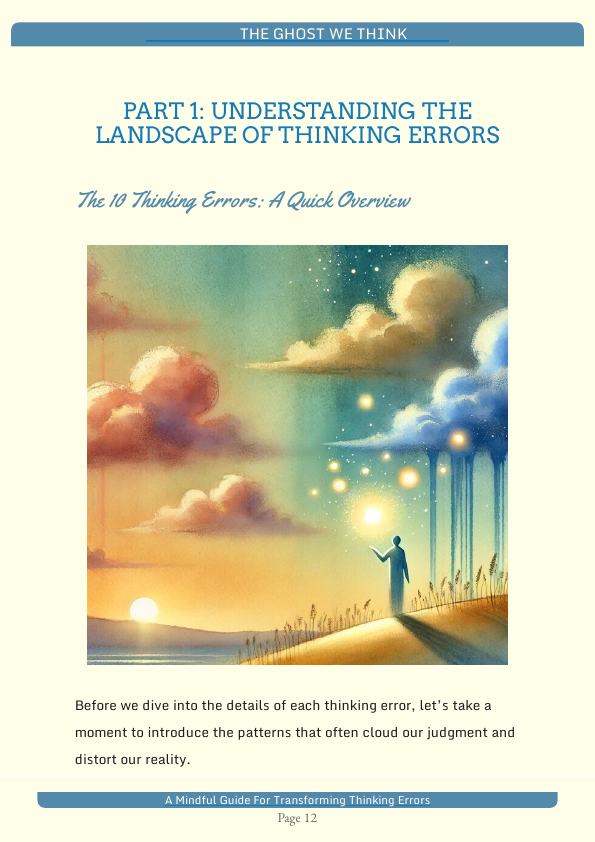
PART 1: UNDERSTANDING THE LANDSCAPE OF THINKING ERRORS
The 10 Thinking Errors: A Quick Overview
Before we dive into the details of each thinking error, let’s take a moment to introduce the patterns that often cloud our judgment and distort our reality.
These thinking errors are mental habits that can sneak into your thoughts without you even noticing. By understanding these errors, you’ll be better equipped to recognize and challenge them when they arise. As Frank Outlaw once said:
“Watch your thoughts, for they will become your words. Watch your words, for they will become your actions. Watch your actions, for they will become your habits. Watch your habits, for they will become your character. Watch your character, for it will become your destiny.”
Our thoughts hold immense power—they shape how we act, react, and ultimately live. Recognizing these thinking errors is the first step toward taking charge of your mind and steering your life in a meaningful direction.
Here’s a brief overview of the 10 common thinking errors:
- Catastrophic Thinking (Fortune Telling)Assuming the worst possible outcome without evidence or automatically predicting negative results.
- Discounting the PositiveMinimizing or dismissing positive events, achievements, or qualities, and focusing solely on the negatives.
- Unfair ComparisonComparing yourself to others in a biased way, often focusing on their strengths while downplaying your own.
- Mind-Reading (Telepathy)Believing you know what others think or feel, typically something negative without clear evidence or communication.
- PerfectionismHolding yourself or others to impossible standards of flawlessness, making it hard to accept anything less.
- Overgeneralization (Labeling)Making broad negative conclusions from a single occurrence or limited information often results in unfair labeling of oneself or others.
- Black-or-White ThinkingSeeing situations, people, or events in extremes—good or bad, success or failure—with no middle ground.
- Personalization (Blaming)Taking excessive responsibility for negative events or blaming others without considering external factors.
- Emotional ReasoningBelieving that feelings are facts—for example, thinking something must be true just because it feels true.
- Mental Filter (Tunnel Vision)Focusing exclusively on negative details or events, excluding the positive or neutral ones, leading to a distorted and overly pessimistic view of situations.
These thinking errors can distort how you see yourself, others, and the world around you. In the next section, we’ll explore each error in greater detail, along with examples and strategies to overcome them.

1: Catastrophic Thinking
When the Mind Plays ‘What If?
“When catastrophic thinking takes hold, it feels like chaos—an uncontrollable storm filling your mind. But you are not the storm. You are the observer, capable of stepping back and finding calm.”
A Mind Full of Storms
Imagine standing on the shore, watching the calm sea stretch before you. The waves roll gently, and everything feels steady. But suddenly, clouds begin to gather. The sky darkens. A storm forms, and in an instant, the sea becomes wild and violent.
This is what catastrophic thinking feels like. Your mind, which was calm just moments before, becomes overwhelmed with chaos—spiraling thoughts of disasters and worstcase scenarios. A small problem, like forgetting to reply to an email or making a tiny mistake, quickly turns into thoughts of total destruction: “What if I lose my job?” “What if I can’t pay rent?” “What if my whole life falls apart?” It’s as if a single raindrop has triggered a hurricane, filling your head with floods, fires, and crashing ships.
What Is Catastrophic Thinking?
Catastrophic thinking, often called fortune-telling, happens when your brain jumps to the worst-case scenario without evidence. It’s when a single thought snowballs into an imagined catastrophe. You might recognize catastrophic thinking when you say or think: “What if I fail this test and ruin my future?” “What if I’m late and everything falls apart?” “What if this headache is something serious?”
At its core, catastrophic thinking turns uncertainty into disaster. It makes the worst-case scenario feel not just possible—but inevitable.
Why Do We Think This Way?
Catastrophic thinking isn’t your fault—it’s your brain’s way of trying to protect you. Here’s why:
- A Survival Instinct That Overreacts
Our ancestors survived by expecting the worst—it was like carrying an umbrella in case of storms. But today, this instinct turns small challenges into imagined disasters.
- The Brain’s Panic Button
Your amygdala, the brain’s fear center, acts like an over-cautious GPS. Even minor bumps in the road, like a missed email, can feel like being lost in a dark forest.
- A Spotlight on the Negative
The brain’s negativity bias is like a spotlight, focusing on what might go wrong while leaving the positives in the shadows. The result? Small uncertainties feel like looming disasters, even when the reality is far less dramatic.

The Runaway Train: A Metaphor for Catastrophic Thinking
Imagine your thoughts as a train sitting quietly at the station. It begins with one small thought—manageable, even reasonable: “I made a mistake.” But then the train starts moving:
“My boss will think I’m unreliable.” “I’ll lose my job.” “I’ll never recover from this.” Before you know it, the train speeds toward disaster, and you feel like a helpless passenger. But here’s the truth: You are not a passenger—you’re the conductor. You can slow the train, stop it, or even change tracks.
How to Stop Catastrophic Thinking?
The key to managing catastrophic thinking is to recognize it early, challenge its influence, and respond with calmness and greater clarity. These tools, drawn from mindfulness, CBT (Cognitive Behavioral Therapy), and ACT (Acceptance & Commitment Therapy), will help you take control.
- Anchor Yourself in the PresentMindfulness
When catastrophic thoughts pull you into an imagined future, mindfulness brings you back to now.
Try This Exercise:
Sit comfortably and close your eyes. Take three deep breaths, feeling your body relax as you exhale. Picture your catastrophic thoughts as storm clouds drifting through the sky. You don’t need to fight or chase them—just watch them come and go. Repeat silently: “These are just thoughts, not facts. I am here, and I am safe.” As you breathe out slowly, allow the storm to subside more and more. Why It Helps: Mindfulness helps you observe your thoughts without becoming overwhelmed. Like the sky holding the clouds, you remain steady as the storm passes.
- Challenge the ThoughtCBT
Thoughts feel real, but that doesn’t make them accurate. Use the Evidence Test to challenge catastrophic thoughts: Steps to Challenge Your Thought:
Identify the Thought: Write it down (e.g., “I’ll lose my job because I made a mistake.”). Examine the Evidence: What evidence supports this thought? What evidence does not support it? Replace It with a Balanced Thought: “I made a mistake, but I can fix it. My boss knows I work hard; one mistake doesn’t define me.” Why It Helps: Most catastrophic thoughts don’t stand up to logic. By testing the evidence, you’ll see the thought for what it is: an exaggerated fear, not reality.
- Defuse from the ThoughtACT
ACT teaches us that thoughts are just thoughts—not facts. You don’t need to fight them; you can simply observe them. Try This Defusion Exercise: When a catastrophic thought appears, tell yourself, “I’m noticing that my mind is telling me a story about failure.” Imagine placing the thought on a leaf and watching it float down a stream. Gently remind yourself: “This is just a thought. I don’t have to act on it.”
Why It Helps: Defusion creates space between you and the thought, so it no longer feels overwhelming or in control. Here’s a YouTube video that will guide you on the ‘leaves on a stream’ exercise:
Reflection: What If the Storm Never Comes?
Take a moment to ask yourself:
- What evidence do I have that the worst-case scenario will happen?
- What is a more balanced and realistic way of viewing this situation?
- What would change if I didn’t believe every catastrophic thought my mind offers?
Most storms never come. By challenging catastrophic thoughts, you free yourself from imaginary fears and focus on what’s real.
A Final Thought
Your brain may sound alarms, but you are not the alarms. You are the calm conductor of your thoughts, the steady observer of the storm, the sky that holds the clouds without letting them take over. As Mark Twain once said:
“I’ve had a lot of worries in my life, most of which never happened.”
Catastrophic thoughts will come—that’s part of being human. But remember, FEAR often stands for False Evidence Appearing Real. Most of the time, what we imagine isn’t as bad—or as likely—as it seems. Do you see a ladybird or a spider? With practice, you can learn to see, question, and let these thoughts pass. Because the storm isn’t forever, and the calm is always waiting underneath.
Looking Ahead: Discounting the Positive
In the next chapter, we’ll explore another thinking error that clouds our view: Discounting the Positive. It’s the habit of skipping over achievements, dismissing compliments, and focusing only on what’s wrong. Let’s uncover how to notice—and celebrate—the good that’s already there. Before that, I’d like to share a song I’ve made, “Thoughts Are Like Farts: Just Let Them Flow.” CHORUS: Let it pass, let it go; It’s just a thought, not a fact, you should know. Like a fart in the wind, it’s not here to stay; Notice it, name it, and send it away.
▶ Listen: Thoughts Are Like Farts — Just Let Them Flow on YouTube
It’s a humorous reminder that not every thought needs to be held onto—some are best released with a laugh! The catchy chorus emphasizes mindfulness, encouraging us to recognize thoughts without judgment and let them pass like a breeze. It’s a fun way to lighten the mood and remember that it’s okay to let go of what doesn’t serve us.
Summary
Feel free to write down any after-reading insights and thoughts. After reading this, I feel right now...

2: Discounting the Positive
Skipping Over the Good Stuff
“Discounting the positive is like focusing on a single black balloon in a room filled with vibrant, colorful ones. The black balloon is real—it’s there—but so are the dozens of bright, joyful balloons that represent your successes, strengths, and wins—if only we choose to see them.”
The Black Balloon in a Room Full of Color
Imagine entering a room filled with colorful balloons—bright reds, sunny yellows, calming blues, and vibrant greens. Each balloon represents a success, a compliment, or a moment of joy in your life. But as you look around, your eyes land on a single black balloon, sitting deflated on the floor. Your mind latches onto it. “Why is that balloon here?” you wonder. The colorful balloons fade from view as you fixate on the black one, dismissing everything else. This is discounting the positive—a mental habit where we overlook our successes, dismiss our achievements, and focus only on the negatives, no matter how small.
What Is Discounting the Positive?
Discounting the positive happens when you: Ignore compliments or praise, assuming they’re undeserved. Dismiss achievements as “no big deal.” Minimize good experiences by telling yourself, “Anyone could have done this.” Focus solely on the one thing that went wrong, even when many things went right.
It’s like training your brain to filter out the good stuff while magnifying the bad—leaving you feeling unfulfilled, unappreciated, and never “good enough.”
Why Do We Discount the Positive?
- The Brain’s Negativity Bias:
Our brains evolved to pay more attention to negative experiences because, in the past, they were often tied to survival. Today, this bias causes us to dwell on criticisms and mistakes while brushing off praise and success.
- Fear of Pride or Complacency:
You may worry that acknowledging your wins will make you arrogant or lazy. So, you downplay your accomplishments to “stay humble” or keep pushing forward.
- Perfectionism:
Perfectionists hold themselves to impossibly high standards. If something isn’t flawless, they see it as a failure—even if 99% of it went well. The result? You feel like you’re always falling short, even when you’re doing just fine—or even thriving.
The Metaphor: The Black Balloon
Think of your mind as a room full of colorful balloons. Each balloon represents a moment of success, joy, or progress in your life. But when you focus solely on the black balloon—the one mistake, flaw, or imperfection—it’s as though the other balloons disappear. The truth is that the black balloon doesn’t define the room. The bright, colorful balloons are still there, waiting to be noticed.
How to Stop Discounting the Positive?
Here are three strategies, drawn from mindfulness, CBT, and ACT, to help you embrace your wins and see the positives in your life.
- Shine a Light on SuccessMindfulness
When you dismiss the positive, it’s often because you’re not paying attention to it. Mindfulness helps you slow down, notice, and fully appreciate the good moments.
Try This Exercise:
- Reflect on Three Positive Things: At the end of each day, take a few minutes to reflect on three positive things that happened. These can be small, like:
“I made someone smile today.” “I completed my to-do list.” “I enjoyed a quiet cup of tea.”
- Let It Sink In: For each positive thing, pause and let it sink in. Imagine it like inflating a colorful balloon in your mind, filling it with joy, gratitude, or satisfaction from the moment. As you breathe out, visualize the balloon gently floating into the sky, carrying your gratitude upward and leaving you with a sense of calm.
- Use Mala Beads for reflection: Hold a set of mala beads as you reflect on your three positive things. Touch one bead for each thought, letting the tactile sensation anchor you in the moment. Focus on the bead in your hand as you review each good thing, savoring the sense of gratitude it brings before moving to the next bead. This practice can help turn your reflection into a calming daily ritual.
Why It Helps: Mindfulness trains your brain to notice and savor the positives instead of letting them slip unnoticed.
- Challenge the “Yeah, But…”CBT
When someone compliments you or when you achieve something, do you find yourself saying, “Yeah, but…”? “Yeah, but it wasn’t perfect.” “Yeah, but anyone could have done it.” “Yeah, but I could’ve done better.” CBT teaches us to challenge these dismissive thoughts by asking: What evidence supports this thought? (Is it true that “anyone” could’ve done this?) What evidence challenges this thought? (Is there proof that this achievement took effort, skill, or care?) How would I respond if a friend told me this? (Would you dismiss their success, or would you celebrate it?) Example: You finish a big project, but your mind says, “Yeah, but I could’ve done it faster.” Challenge it: “I worked hard on this project, and I finished it well. I deserve to feel proud of my effort.” Why It Helps: Challenging your automatic dismissals helps you see your achievements more accurately.
- Accept & DefuseACT
In ACT, acceptance doesn’t mean resigning to negative thoughts—it means acknowledging them without letting them control you.
Try This Exercise:
When your mind says, “This isn’t a big deal,” pause and say: “I hear you, mind, but I’m going to appreciate this moment anyway.” Imagine holding the thought in your hands like a small black balloon. Then, look around and notice the colorful balloons, too—the other parts of the moment that are positive and true.
Why It Helps: Defusion allows you to hold space for the negative thoughts without letting them erase the positive ones.
Reflection: What Are Your Balloons?
Take a moment to reflect:
- What are three positive things you’ve accomplished recently?
- How did you dismiss them? (“It wasn’t good enough” or “Anyone could’ve done it”)
- What would change if you paused to acknowledge and celebrate them instead? Your room isn’t just full of black balloons. There are bright, colorful ones, too—waiting for your attention.
A Final Thought
When you discount the positive, you rob yourself of joy, satisfaction, and confidence. You focus on the single black balloon while ignoring the beauty and color surrounding you.
Remember:
“We often take for granted the things that deserve our gratitude the most.”
Every success, big or small, is worth noticing. Seeing and accepting the positives will create a fuller, brighter view of your life.
Looking Ahead: Unfair Comparisons
In the next chapter, we’ll explore the habit of comparing ourselves to others—a thinking error that often steals joy and leaves us feeling inadequate. Together, we’ll learn how to focus on our unique journey and appreciate our progress. But before we move forward, let’s revisit the idea of celebrating the good—something we explored in this chapter on Discounting the Positive. To help you reflect, here’s a song I’ve composed: “Magic of Life: Count the Blessings” A cheerful tune about gratitude, contentment, and noticing the bright moments that often get overlooked.
As you listen, take a moment to appreciate the “colorful balloons” in your life—the small and big moments that make it meaningful. Because when we focus on what’s good, the light shines even brighter.
Summary
Feel free to write down any after-reading insights and thoughts. After reading this, I feel right now...

3: Unfair Comparison
Measuring Yourself with the Wrong Ruler
“Measuring yourself with someone else’s ruler will always leave you feeling small. Focus on your own gifts, your own path, and your own race.”
The Fish, the Giraffe & the Ruler
Imagine a fish underwater, staring at a giraffe standing tall on land. Between them is a measuring scale, and the giraffe towers at the top. The fish looks up, sighs, and thinks, “I’ll never be as tall as that.”
Now, this thought is absurd—fish aren’t meant to measure themselves by a giraffe’s height. The fish has strengths of its own: it swims, glides, and breathes underwater. But none of that matters because it’s comparing itself using the wrong ruler. This is the trap of unfair comparison. We measure ourselves against others, focusing on their strengths and overlooking our own. Someone else seems happier, smarter, wealthier, fitter, prettier, or more successful, and suddenly, we feel “less than.” But what if the problem isn’t you? What if you’re just using the wrong ruler?
What Is Unfair Comparison?
Unfair comparison happens when you judge yourself against someone else—often in a way that sets you up to lose. It’s the habit of: Comparing your weaknesses to someone else’s strengths. Focusing only on what others have, while ignoring your own gifts. Measuring your “behind-the-scenes” against someone else’s “highlight reel.” You might hear it in thoughts like:
“They’re so successful. Why can’t I be like that?” “She’s so confident. I’ll never feel that way.” “Everyone else has it figured out. I’m falling behind.” The result? Unfair comparison leaves you feeling inadequate, unworthy, and stuck.
Why Do We Compare Ourselves?
Comparing yourself to others is natural—it’s something humans have always done. But in today’s world, it has become far more damaging. Here’s why:
- Evolutionary Instinct:
Thousands of years ago, comparing ourselves to others helped us survive. If someone was faster, stronger, or better at finding food, we learned to adapt and improve. But now, this instinct often leads to unnecessary competition and insecurity.
- Social Media Highlight Reels:
We live in an age where people share their best moments online—promotions, vacations, and achievements. But we rarely see their struggles or behind-the-scenes reality. This creates an illusion that everyone else is thriving while we’re falling behind.
- The “Should” Trap:
Society gives us unspoken “rules” for success: “By this age, you should have a career, a family, a house…” If your life doesn’t match those expectations, comparison fuels feelings of failure. The problem? Comparison ignores the uniqueness of your journey. Like the fish and the giraffe, we all have different strengths, challenges, and purposes.
The Metaphor: The Wrong Ruler
Comparing yourself to someone else is like measuring a fish’s swimming skills with a giraffe’s ruler. The fish feels inadequate because it can’t stand tall, even though standing tall was never its purpose. It forgets its strengths—speed, grace, and ability to breathe underwater—because it’s too focused on what it can’t do. You’re not here to be someone else. You’re here to be you.
How to Stop Unfair Comparisons?
The antidote to comparison isn’t to stop noticing others—it’s to shift how you think about yourself and the people around you. Drawing from mindfulness, CBT, and ACT, these tools will help you find balance.
- Notice & Name the ComparisonMindfulness
Comparison often happens automatically. The first step is to notice it and give it a name to help recognition. Examples: “Greener Grass Syndrome,” “Jealosy FM,” “NGE: Not-Good-Enough Virus,” “Better Than Me TV,” “Comparison Ghost,” “Reel Bugs,” or “Self-Doubt Scammer.”
Try This Exercise:
The next time you find yourself comparing, pause and say: “I’m noticing that I’m comparing myself to [person/situation].” Ask yourself: “What triggered this comparison?” (Was it social media, a conversation, or someone’s success?) “Is this comparison helpful or fair?” Mindfulness helps you catch comparison in the moment and prevents it from spiraling into a storm.
- Challenge the RulerCBT
When you compare yourself unfairly, you’re measuring yourself with a biased standard. Challenge it with these steps: Is this a fair comparison? Are you comparing your struggles to someone else’s success? Are you overlooking your progress or strengths? What are my strengths in this situation? If someone excels in one area, remind yourself of your skills and achievements—no matter how small. What’s my purpose or goal? Ask: “Does their success change my path? Am I on my own journey?” Example: You see a friend buy a house and think, “I’m so far behind.” Challenge it: “Our lives are different. I’ve been focusing on my education and personal growth, and that’s valuable, too.”

Why It Helps: CBT helps you reframe comparisons so they’re fair, balanced, and aligned with your values.
- Focus on Your Own RaceACT
In ACT, you learn to accept thoughts without letting them control you. Comparison doesn’t disappear overnight, but you can shift your focus back to your own path.
Try This Visualization:
Imagine running a race. The track beside you is crowded with other runners. Some are ahead, some are behind. Now, picture your own lane—clear, open, and made just for you. Remind yourself: “Their race isn’t my race. I’m running at my own pace.” Unfair comparison often pulls us into someone else’s story—a race that isn’t ours to run. But when you pause and return to what matters to you, you’ll see that your path has unique priorities, values, and goals. For instance, when I park my car at the hospital, I can’t help but notice the rows of luxury cars—Mercedes-Benz, BMW, Porsche, etc. My own car? An economical car. How do I feel when I see those shiny, expensive cars? Am I jealous? No. Why? Because those cars don’t fit into my race. My family and I don’t require a luxury car. We prefer to invest our money in areas such as health, food, books, quality education, and meaningful experiences together. A larger, more extravagant car wouldn't significantly enhance my life. This perspective is what focusing on your own race looks like. It’s about stepping back and asking yourself:
What truly matters to me? What do I value most in life? Am I running toward my goals, or getting distracted by someone else’s race? The next time an unfair comparison arises—whether it’s about cars, houses, careers, or achievements—gently remind yourself to return to what matters to you. Your race is unique, and your priorities are yours to define. Stay on your track, and let others run theirs.
Reflection: Celebrating Your Strengths
Take a moment to reflect:
- What are three strengths or qualities that make you unique?
- When was a time you felt proud of your progress?
- What would change if you measured yourself by your values instead of someone else’s achievements?
A Final Thought
As a quote attributed to Albert Einstein states:
“Everybody is a genius. But if you judge a fish by its ability to climb a tree, it will live its whole life believing that it is stupid.”
Stop measuring yourself with someone else’s ruler. The giraffe’s height doesn’t diminish the fish’s ability to swim. Both are valuable—just in different ways. You have your strengths, your path, and your race to run. Focus on that, and the comparisons will fade.
Looking Ahead: Mind-Reading
In the next chapter, we’ll explore the habit of assuming we know what others think—often with little or no evidence. Mind-reading can leave us anxious, misunderstood, and disconnected. Let’s learn to communicate clearly and stop guessing what’s on someone else’s mind.

4: Mind-Reading
Assuming We Know What Others Are Thinking
“Mind-reading fills our heads with chaotic assumptions—most of which are negative and false. Let go of the stories, and the cloud begins to clear.”
The Chaotic Thought Bubble
Imagine walking through a crowded city street surrounded by people. Everyone looks calm, busy, and focused. But above your head floats a giant bubble—a swirling cloud of thoughts and assumptions:
“She probably thinks I’m awkward.” “They’re judging my outfit.” “Everyone knows I’m not good enough.” The bubble grows bigger and more chaotic with every step, filling with imaginary judgments, unspoken criticisms, and wild interpretations of what people might be thinking. Before long, you’re weighed down by a storm of assumptions—so convinced you know what others think of you that you forget to enjoy the moment. This is mind-reading: the belief that we can interpret other people’s thoughts, often assuming the worst.
What Is Mind-Reading?
Mind-reading happens when you: Assume you know what others are thinking without evidence. Believe people are judging you negatively (e.g., “They think I’m boring.”). Imagine hidden meanings behind someone’s words or behavior (e.g., “They didn’t reply quickly. They must be upset with me.”). Mind-reading sounds like: “He didn’t say hi. He must not like me anymore.” “She looks distracted—she’s probably annoyed with me.” “Everyone at the meeting thinks I’m incompetent.”
At its core, mind-reading is the mind filling in blanks with unhelpful stories—usually negative ones.
Why Do We Mind-Read?
Mind-reading is a defense mechanism. We assume the worst to prepare ourselves for rejection or criticism. It’s our brain’s attempt to “stay safe” by anticipating what others think of us. But in reality:
- The Brain Hates Uncertainty:
When we don’t know what someone thinks, our brain fills in the blanks. It’s like a detective jumping to conclusions before gathering evidence.
- Negativity Bias:
Our minds are wired to focus on negative possibilities. Instead of thinking, “They’re probably busy,” we assume, “They’re upset with me.”
- Fear of Rejection:
As social creatures, we’re wired to seek connection and belonging. Mind-reading stems from the fear that others disapprove of us—so we “read” their behavior for signs of judgment. The problem? Mind-reading doesn’t actually keep us safe. Instead, it fuels anxiety, erodes confidence, and damages relationships.
The Metaphor: The Cloud of Assumptions
Mind-reading is like walking through life with a cloud of assumptions hanging over your head. The cloud is heavy, chaotic, and filled with imaginary thoughts—most of which have no basis in reality. The people around you? They’re busy carrying their own clouds. They’re not judging you nearly as much as you think. Most of the time, they’re not thinking about you—they’re focused on their own lives, worries, and stories.
How to Stop Mind-Reading?
To break free from mind-reading, you need to: Catch yourself making assumptions. Challenge those thoughts. Practice clear communication and curiosity. Here are three powerful strategies based on mindfulness, CBT, and ACT to help you stop mind-reading and gain clarity.
- Pause & Notice the ThoughtMindfulness
Mind-reading happens automatically, slipping into your mind like an invisible virus. The first step is simply to notice it. Imagine you’re running a mental antivirus program designed to catch the "mindreading bug" before it spreads. Mindfulness isn’t about fixing the thought immediately—it’s about recognizing it for what it is, without judgment.
Try This Exercise:
Pause & Name the Thought: When you notice yourself assuming what someone else is thinking, pause and give the thought a playful or descriptive name. Examples of names: “Detective Me” – When your mind is trying to “solve” what others think. “Assumption Airlines” – When your thoughts are taking wild flights of imagination. “The Psychic Network” – For when you think you’re reading someone’s mind like a TV psychic. Naming the thought helps you step back and observe it with humor rather than getting caught in it. Enhance Recognition with Skillful Means: Use visual reminders like posters or sticky notes with affirmations: “Not a Psychic!” “Pause—Mind-reading in Progress.” “What’s in my head isn’t in theirs.”
Create Space with Awareness: Simply acknowledge the thought: “I’m noticing that I’m mind-reading right now.” Visualize the thought floating by, like a cloud or a bubble. You don’t need to pop it or fix it—just let it drift away. Why It Helps: By noticing and naming your mind-reading thoughts, you practice mindfulness and create the space to move through them with awareness and ease.
- Challenge the AssumptionCBT
Mind-reading often relies on faulty “evidence” (like a look, a tone, or a delayed response). Use CBT techniques to test your assumptions: What’s the evidence? “What actual proof do I have that they’re judging me?” What’s a more realistic explanation? “Maybe they’re having a tough day, or maybe they’re distracted.” How would I know for sure? If you’re close enough, ask the person directly instead of guessing.
Example: Assumption: “He looked annoyed in the meeting. He must hate my idea.” Reframe: “He might just be tired or thinking hard. I can’t know for sure unless I ask.” Why It Helps: Challenging your assumptions stops the mind-reading spiral and grounds you in reality.
- Ask Instead of AssumingACT
Instead of trying to guess what someone is thinking, practice curiosity and openness—a core principle and value of ACT.
Try This Exercise:
If you feel uncertain about someone’s behavior, ask directly (kindly and calmly): “I noticed you seemed quiet earlier. Is everything okay?” If you can’t ask, remind yourself: “I don’t know what they’re thinking—and that’s okay.” Let go of the need to control or predict someone else’s thoughts. It’s not your job to know.
Why It Helps: ACT encourages you to accept uncertainty rather than fight it, freeing you from the exhausting habit of mind-reading.
Reflection: Whose Thoughts Are You Carrying?
Take a moment to reflect:
- Who do you often mind-read? (A boss, a friend, a partner?)
- What assumptions do you make about what they think of you?
- How would your life change if you let go of those assumptions? Most of the time, the people around you are too busy with their own thoughts to judge you. You don’t need to carry their imagined opinions. Here’s a modern reminder to help you let go:
NONYA—None of Your Business!
This playful slang serves as a mental cue to step back and realize that most of the time, the people around you are too busy with their own thoughts to be judging you. Their imagined opinions are not your responsibility to carry. By embracing “NONYA,” you can focus your energy on what truly matters: your own well-being, actions, and values. Let their thoughts stay with them, and carry only your own.
A Final Thought
Mind-reading keeps you stuck in a cycle of worry and disconnection. As much as you think you know what others are thinking, you don’t—and that’s okay. There’s a classic saying about assumptions:
“When you ASSUME, you make an ass out of you and me.”
It’s a light-hearted reminder that jumping to conclusions rarely serves us well.
As Byron Katie once said:
“What other people think of me is none of my business.”
Instead of filling in the blanks with assumptions, focus on what you do know: your values, your truth, and the things you can control. Let the thought bubbles go. Most of them were never yours to carry.
Looking Ahead: Perfectionism
In the next chapter, we’ll tackle another thinking error: Perfectionism. It’s the belief that everything must be flawless—and the stress that comes when it’s not. Let’s learn how to aim for progress instead of perfection.

5: Perfectionism
When ‘Good Enough’ Never Feels Good Enough
“Perfectionism feels like standing under endless clouds of MUST, SHOULD, and PERFECT. But you don’t have to stay there—good enough is good enough.”
The Pencil Under Pressure
Picture a pencil, sweating, trembling, and exhausted. It’s surrounded by mountains of papers, unfinished lists, and deadlines. Above it hangs three dark clouds:
MU ST
SHO ULD
PERF ECT
The pencil looks panicked, its mind overwhelmed by impossible expectations: “This MUST be flawless.” “I SHOULD do better.” “Everything has to be PERFECT.” This is the reality of perfectionism: a constant rain of pressure, unrealistic standards, and the belief that nothing you do is ever good enough.
What Is Perfectionism?
Perfectionism is the belief that you must perform flawlessly—or not at all. It’s driven by high, often unattainable standards and a fear of making mistakes. Perfectionism sounds like: “If it’s not perfect, it’s a failure.” “I can’t stop until this is flawless.” “People will judge me if I make a mistake.” At first, perfectionism may seem helpful. You might think it pushes you to excel. But over time, it becomes a heavy burden that:
Fuels stress and burnout. Stops you from starting tasks for fear of failure. Leaves you dissatisfied, even when you succeed. Perfectionism doesn’t drive you toward greatness—it paralyzes you.
Why Do We Struggle with Perfectionism?
- Fear of Failure:
Perfectionism often stems from a fear of being criticized, judged, or seen as “not enough.” Mistakes feel like proof of inadequacy, so you work tirelessly to avoid them.
- The “Should” Trap:
Thoughts like “I SHOULD do this perfectly” or “I MUST meet everyone’s expectations” create immense pressure, leaving no room for flexibility or self-compassion.
- External Validation:
Perfectionism ties your self-worth to outcomes—grades, praise, or accomplishments. If something isn’t perfect, you feel like you aren’t good enough.
- All-or-Nothing Thinking:
Perfectionists see results as “perfect” or “failure”—nothing in between. If one detail goes wrong, the entire effort feels ruined.
The irony? Perfectionism doesn’t make you more successful—it makes you more anxious, stuck, and exhausted.
The Metaphor: The Drenched Pencil
Perfectionism is like standing under storm clouds labeled MUST, SHOULD, and PERFECT—getting soaked by endless rain. You’re the frantic pencil, juggling expectations and to-do lists, terrified of slipping up. You’re working harder and harder, but you’re not moving forward—you’re just getting wetter. The truth is that perfectionism doesn’t protect you from failure; it keeps you stuck in the storm. When we have overly high expectations in life, we are likely to face disappointment.
How to Let Go of Perfectionism?
To overcome perfectionism, you don’t need to lower your standards—you need to change your relationship with them. Here are three tools, drawn from mindfulness, CBT, and ACT, to help you find freedom from perfectionism.
- Mindful Self-CompassionMindfulness
Perfectionists are often their own harshest critics. Mindfulness teaches you to recognize and replace self-criticism with kindness.
Try This Exercise:
When you feel overwhelmed, pause and take three deep breaths. Gently say to yourself: “It’s okay to make mistakes. I’m doing my best, and that’s enough.” Imagine speaking to yourself like you would a close friend—offering encouragement instead of criticism. Why It Helps: Self-compassion helps you recover from mistakes and keep moving forward rather than getting stuck in self-blame.
- Challenge Your “Shoulds”CBT
Perfectionism thrives on “should” and “must” statements: “I should work harder.” “This must be perfect, or I’ll fail.” “You shouldn’t be lazy.” “People mustn’t disobey me.” These thoughts don’t just create pressure—they’re funny if you think about it from different perspectives. Constantly telling yourself “I should” is like “shooting yourself” in the foot, and those “musts”? They’re what Albert Ellis famously called “musturbatory” thoughts!
To break free, challenge these ideas by asking: Is this expectation realistic? “Does it really have to be perfect, or is it good enough for the current needs?” “Can I fully control how others think or behave?” What would I say to a friend? Would you expect perfection from them or offer encouragement? Can I replace ‘should’ or ‘must’ with ‘could’? “It could be better, but it’s good enough for what’s needed right now.” Why It Helps: By ditching the “shoulds” and “musts,” you allow flexibility, self-compassion, and maybe even a little laugh at how serious those words can make things feel.
- Practice “Good Enough”ACT
Perfectionism can hold you back because it sets impossible standards to reach. Acceptance & Commitment Therapy (ACT) focuses on being adaptable and flexible in your thoughts and actions. One helpful concept is pragmatic perfectionism. This means understanding that while aiming for perfection might seem appealing, what’s more important is striving for the best version of what you can realistically accomplish right now. That is more than enough. Ask Yourself: What’s a realistic goal for this task? “What can I achieve right now that meets the needs of the situation?” Can I accept my ‘possible best’? Replace thoughts like “This isn’t good enough” with: “This is the best I can do given the current circumstances, and that’s okay.” What matters most: finishing or perfecting? Focus on completing the task rather than perfecting every detail. Example: You think, “This project has to be flawless, or it won’t succeed.” A Mindful Guide For Transforming Thinking Errors
Reframe:
“I’ve put in effort; this is my best work, given the time and resources. It may not be perfect, but it’s what’s possible right now.”
Why It Helps: By embracing pragmatic perfectionism, you allow yourself to move forward with confidence, knowing your work is good enough for the current circumstances.
Reflection: Good Enough & Growth Mindset
Take a moment to reflect:
- What areas of your life are ruled by perfectionism? Is it at work, in relationships, or with your appearance?
- What would change if you allowed yourself to be “good enough” instead of perfect? How would this shift free up energy to focus on learning and progress?
- How much more could you accomplish if you let go of the fear of mistakes? Remember, mistakes aren’t failures—they’re opportunities to grow.
Perfection is an unattainable ideal, while progress is a dynamic process that flourishes within a growth mindset. This concept, popularized by psychologist Carol Dweck, emphasizes that our abilities and intelligence can be developed through dedication and hard work. Adopting a growth mindset encourages us to embrace challenges, learn from failures, and view effort as a pathway to mastery.
In this framework, achieving "good enough" is not a failure—it's a vital stepping stone toward further growth. It allows us to free ourselves from the pressure of unrealistic standards, making room for continuous improvement and forward movement. By fostering a mindset that values progress over perfection, we open ourselves up to endless possibilities for learning and personal development.
A Final Thought
Perfectionism isn’t about high standards—it’s about fear. Fear of mistakes, judgment, and not being enough. As author Brené Brown reminds us:
“Perfectionism is not the same thing as striving to be your best. Perfectionism is the belief that if we live perfectly, look perfectly, and act perfectly, we can avoid the pain of blame, judgment, and shame.”
Let go of perfect. Embrace “good enough.” That’s where freedom, creativity, and real success begin.
Looking Ahead: Overgeneralization
In the next chapter, we’ll explore Overgeneralization—the habit of turning one mistake into an “always” or “never” statement. Let’s learn how to break free from this distorted thinking and see setbacks as single moments, not permanent failures.
Summary
Feel free to write down any after-reading insights and thoughts. After reading this, I feel right now...

6: Overgeneralization
Turning One Event Into ‘Always’ or ‘Never'
“Overgeneralization creates storm clouds of ‘always’ and ‘never.’ But one moment doesn’t define the whole sky—there’s always light behind the clouds.”
The Storm Clouds of “Always” & “Never”
Imagine sitting at your desk, staring at an open book. Above you, two dark clouds gather: one says “ALWAYS”, the other “NEVER”.
These clouds are heavy, stormy, and relentless. One missed opportunity becomes: “I ALWAYS mess up.” One rejection turns into: “I’ll NEVER succeed.” These words—“always” and “never”—are like thunderstorms in your mind. They take a single raindrop of failure or disappointment and stretch it into a storm that covers your whole life. This is an overgeneralization: the habit of drawing broad, negative conclusions based on a single event or limited evidence.
What Is Overgeneralization?
Overgeneralization happens when we take one experience and decide it applies to everything. It’s a form of binary thinking that leaves no room for nuance or balance. Common examples include: After failing a test: “I’m stupid. I’ll NEVER succeed in school.” After a bad date: “I ALWAYS mess up relationships. I’ll NEVER find love.” After missing a deadline: “I ALWAYS fail at work. I’ll NEVER get it right.” These extreme statements feel final and absolute, trapping you in a cycle of hopelessness.
Why Do We Overgeneralize?
- The Brain Loves Shortcuts:
Our brains are wired to look for patterns. Overgeneralization is a mental shortcut—taking one event and deciding it defines the whole story.
- Negativity Bias:
Negative experiences leave a stronger impression than positive ones. One setback can feel like proof that you “always” fail, even if it’s just one moment.
- Emotional Reasoning:
When you feel bad—hurt, rejected, or frustrated—it’s easy to believe those feelings reflect the truth. “I feel like a failure, so I MUST always fail.” The problem? Overgeneralization distorts reality. It ignores the many times you succeeded, grew, or learned and focuses only on the one time you didn’t.
The Metaphor: The Storm Clouds
Overgeneralization is like letting two dark clouds—ALWAYS and NEVER—hover over your mind.
These clouds block the sunshine of your achievements, joys, and growth. They make everything feel gray and hopeless. But here’s the truth: One storm doesn’t mean the sky is always dark. One setback doesn’t mean you’ll never succeed. The storm clouds only seem permanent because you’ve stopped looking for the clear sky behind them.
How to Challenge Overgeneralization?
The key to overcoming overgeneralization is learning to catch extreme thoughts, challenge their accuracy, and replace them with more balanced perspectives. Here are three practical tools to help you:
- Spot the “Always” & “Never”Mindfulness
Overgeneralization often happens so quickly that we don’t notice it. The first step is to become aware of the language you’re using and soften its extremes.
Try This Exercise:
Pause and Listen to Your Thoughts: When you feel upset or defeated, stop and observe what you’re telling yourself. Look for Extreme Words: Notice words like: “always,” “never,” “every time,” or “no one.” Challenge the Absolutes: Ask: “Is this really true all the time?” “Can I think of one example where this isn’t the case?” Introduce Softer Language: Replace absolutes with gentler phrases like: “SOMETIMES this happens, but not always.” “A part of me feels this way right now, but it’s not the whole story.” Example: Thought: “I NEVER get things right.” Pause & Reframe: “Is that true? Haven’t I completed many tasks successfully before?” “SOMETIMES I make mistakes, but I also succeed a lot.” “A part of me feels frustrated, but I know I’m capable of growth.”
Why It Helps: Using words like “SOMETIMES” and “A part of me” adds balance and perspective. It reminds you that your thoughts don’t define your whole reality—they’re just one piece of the bigger picture. Mindfulness helps you catch and reframe these extremes before they spiral into storms.
- Find the ExceptionsCBT
Overgeneralization thrives on absolutes. Challenge it by looking for the exceptions—moments when the opposite is true. Steps to Challenge the Thought: Write down the overgeneralized thought. “I ALWAYS fail at presentations.” Find evidence that challenges it. “Actually, last month I gave a presentation that went well, and my team complimented me.” Replace the extreme thought with a balanced one. “Sometimes I struggle with presentations, but I’ve succeeded before, and I can improve.”
Why It Helps: Finding the exceptions breaks the illusion of “always” and “never,” showing you a more balanced and realistic view of yourself.
- Focus on Commitment, Not AbsolutesACT
Overgeneralization often comes from rigid thinking, like expecting “always” or fearing “never.” ACT encourages us to commit to our goals and values and focus on steady progress.
Try This Visualization:
Set Your Goals: Imagine a long path ahead of you, with each step representing meaningful action. Break your journey into: Short-term goals: “What can I do today to align with my values?” Mid-term goals: “What do I want to build over the next few weeks or months?” Long-term goals: “What kind of life am I working toward?” Walk Your Path with Commitment:Visualize yourself walking along this path. Each step forward is progress—learning, growing, and staying aligned with your values. Use Affirmations to Stay on Track: When setbacks arise, pause and affirm: “Every moment, in every way, I’m learning and growing.” “This is just one step in a much bigger journey.”
Example: Instead of thinking: “I’ll NEVER get this right,” Commit to your path and reframe: “I’m taking steps that align with who I want to be, and this one moment doesn’t define my progress.” By focusing on your goals and values rather than rigid absolutes, you can see setbacks as part of the journey—not as the whole story.
Reflection: Clearing the Storm
Take a moment to reflect on these questions:
- What “always” or “never” thoughts do you repeat most often?
- Can you think of examples where those thoughts weren’t true?
- What would change if you replaced those words with more balanced statements? The “always” and “never” storm clouds aren’t permanent. When you challenge these thoughts, the sky begins to clear, and you can see the truth: One moment doesn’t define your whole story.
A Final Thought
Overgeneralization turns small setbacks into permanent failures. It tricks you into believing that one storm means the sky will always be dark. As Mark Twain wisely said:
“Don’t let yesterday use up too much of today.”
One mistake, one bad day, or one rejection doesn’t mean “always” or “never.” It’s just one moment—one step on a much larger journey.
Looking Ahead: Black-or-White Thinking
In the next chapter, we’ll explore Black-or-White Thinking—the habit of seeing life in extremes, like “good or bad” and “success or failure.” Let’s learn how to embrace the middle ground, where life is balanced and real growth happens.

7: Black-or-White Thinking
All or Nothing, Right or Wrong—Where’s the Middle Ground?
“Black-or-white thinking shines a spotlight on extremes—success or failure, perfect or terrible—while ignoring the middle ground. Step off the chessboard and embrace the space where real life happens.”
Life on the Chessboard
Imagine standing on a giant chessboard, surrounded by black and white squares. There’s no gray, no middle ground—just sharp, opposing extremes.
In this world, everything is either: A success or a failure. Perfect or terrible. Good or bad. Right or wrong. There’s no room for “okay,” “enough,” or “in progress.” If you’re not winning, you must be losing. If you’re not the best, you’re the worst. This is black-or-white thinking—also called all-or-nothing thinking. It’s the habit of seeing situations, people, or yourself in extremes, ignoring the nuanced shades of gray that make up reality.
What Is Black-or-White Thinking?
Black-or-white thinking happens when you divide the world into rigid categories. There’s no flexibility, no balance—just a harsh “either/or” mindset. Common examples include: At work: “If I didn’t ace the presentation, it was a complete disaster.” In relationships: “If they don’t agree with me, they must not care about me.” In self-judgment: “If I didn’t finish everything on my list, I’m lazy and unproductive.”
This mindset oversimplifies life, creating unnecessary stress, disappointment, and frustration.
Why Do We Think in Black or White?
- Fear of Uncertainty:
Gray areas feel uncomfortable. Black-or-white thinking provides the illusion of certainty—even if it’s negative.
- Perfectionism:
If you believe something must be perfect to count as a success, anything less feels like failure.
- Strong Emotions:
When you’re upset, it’s easy to see things in extremes: “Everything is ruined!” or “Nothing ever works out!” The problem? Black-or-white thinking blinds you to reality. Life isn’t a chessboard—it’s a spectrum full of colors, possibilities, and second chances.
The Metaphor: The Spotlight on Extremes
Picture the performer in the spotlight, standing on the black-andwhite chessboard. The spotlight shines on the extremes—success or failure, good or bad, right or wrong—while everything in between is left in the dark. But here’s the truth: most of life happens outside the spotlight. The spaces between black and white are where growth, progress, and joy live.
How to Challenge Black-or-White Thinking?
To overcome black-or-white thinking, you need to learn how to embrace the middle ground—where things are balanced, realistic, and kinder. Here are three practical tools based on CBT, mindfulness, and ACT:
- Spot the ExtremesMindfulness
Black-or-white thinking shows up when your mind reduces life to stark opposites: success or failure, good or bad, right or wrong. There’s no room for nuance or shades of gray. To make it easier to notice, let’s call this “Michael Jackson Thinking”—after his famous song, Black or White. When you see only extremes, this nickname can help you spot the pattern and laugh a little, too.
Try This Exercise:
Catch It: When you notice an extreme thought, say: “Oh, that’s Michael Jackson Thinking again!” Question It: Ask yourself: “Is this truly all or nothing?” “What’s the middle ground or third option here?” Reframe It: Replace the extreme thought with one that allows for nuance. “If my friends don’t agree with me, they don’t care about me.” Middle Ground: “It's possible to have differing opinions and still show concern for one another” and “Caring less doesn’t equate to not caring at all.” Why It Helps: Naming the pattern as “Michael Jackson Thinking” makes it easier to spot and less overwhelming. Mindfulness helps you step back, recognize the extremes, and find the middle ground where life happens.
- Find the Shades of GrayCBT
CBT teaches us to challenge rigid, all-or-nothing thoughts by exploring the middle ground. Steps to Find Balance: Write down the black-or-white thought. “I messed up, so I’m terrible at this.” List evidence for and against the thought. For: “I did make a mistake.” Against: “But I’ve succeeded many times before, and I learned something valuable from this.” Replace the thought with a balanced statement. “I made a mistake, but I’m still capable and learning.” Why It Helps: This exercise helps you see that life isn’t either/or—there’s always a middle ground.

- Embrace ‘It Depends’ ThinkingACT
In Acceptance & Commitment Therapy (ACT), life isn’t about rigid labels like “good” or “bad”—it’s about context. Flexible, “it depends” thinking helps you see the bigger picture instead of getting stuck in extremes.
Try This Exercise:
Pause and Ask: “Does this really have to be good or bad, or does it depend on the context?” “What can I learn from this?” Reframe with Curiosity: Example: “Is being hardworking good or bad?” It depends—hard work is valuable when aligned with your values and goals, but overworking can lead to burnout and neglecting other priorities. Instead of: “I failed today,” try: “It depends—did I focus on what mattered most? Example: “I lost the badminton game, but I gained something even more important—I had fun, stayed healthy, and strengthened my friendship with my opponent. Winning the game might feel great, but the connection and shared experience are what really matter in the long run.” This way, you shift your focus from a single outcome to the bigger picture, recognizing the value of growth, connection, and shared moments.
Why It Helps: “It depends” thinking shifts you from rigid judgment to curiosity and growth. It helps you approach situations with a fresh perspective, see lessons in every experience, and align your choices with what truly matters.
Reflection: Stepping Off the Chessboard
Take a moment to reflect:
- What areas of your life feel “all or nothing”? (Work, relationships, personal goals?)
- Can you think of a time when you dismissed progress because it wasn’t perfect?
- What would change if you allowed yourself to embrace the middle ground? Remember: Life isn’t a chess game; you don’t have to stay on the black-and-white squares. You can step off the board and embrace the gray spaces where growth and balance live.
A Final Thought
Black-or-white thinking oversimplifies life, forcing you into rigid categories of success or failure, good or bad. But life is much more complex—and forgiving—than that. As Aristotle wisely said:
“It is the mark of an educated mind to be able to entertain a thought without accepting it in its extremes.”
Let go of the extremes. Life isn’t about choosing between perfection and failure—it’s about showing up, learning, and growing in the shades of gray in between. To help you reflect on this, I’d like to share my song, “What Have I Learned?”—a reflective tune about stepping back to see the lessons hidden in life’s complexities. Listen to this song and consider how moving beyond black-or-white thinking can open your mind to growth, connection, and new possibilities.
Looking Ahead: Personalization & Blaming
In the next chapter, we’ll explore Personalization & Blaming—the habit of taking too much responsibility for what goes wrong (or blaming others entirely). Let’s learn how to take balanced ownership of challenges and see all sides of the story.

8: Personalization & Blaming
When It’s Always Your Fault—or Someone Else
“Personalization and blaming are like being surrounded by pointing fingers—some yours, some others’. But you don’t have to carry all the blame, nor do you need to pass it on. Step back, see the bigger picture, and focus on what you can control.”
The Circle of Pointing Fingers
Imagine standing in the center of a room. Around you, hundreds of hands point accusing fingers—some from others, some your own.
You feel the weight of their judgment: “This is all my fault.” “I should’ve done more.” “They ruined everything.” Whether the blame is aimed at yourself or others, it’s overwhelming. It leaves you trapped—carrying shame, resentment, or frustration. This is Personalization & Blaming: the habit of taking too much responsibility for what goes wrong or blaming others entirely, ignoring the complex reality of any situation.
What Is Personalization & Blaming?
Personalization happens when you blame yourself for events outside your control. It sounds like: “If I had tried harder, this wouldn’t have happened.” “It’s my fault my friend is upset.” Blaming happens when you shift responsibility entirely to others, refusing to look at your role. It sounds like: “It’s all their fault. They ruined everything.” “If they hadn’t acted that way, I’d be fine.” Both patterns distort the truth and keep you stuck.
Personalization leads to unnecessary guilt, shame, and anxiety. Blaming leads to anger, resentment, and broken relationships. Neither approach helps you solve problems, learn, or move forward.
Why Do We Personalize or Blame?
- The Need for Control:
When something bad happens, your mind tries to make sense of it. Taking the blame—or blaming others—gives you the illusion of control.
- Fear of Uncertainty:
It’s easier to say “This is my fault” or “They’re to blame” than to accept that life is messy and not everything has a clear cause.
- Emotional Overload:
When emotions like anger, guilt, or frustration run high, it’s easy to point fingers—at yourself or others—rather than face the situation's complexity.
The Metaphor: The Room of Blame
Personalization and blaming are like being trapped in a room where fingers point relentlessly, either at you or at everyone else.
When you blame yourself, you carry everyone’s burdens, whether they belong to you or not. It’s exhausting and unfair. When you blame others, you give away your power to change things. You’re stuck waiting for them to fix the problem. The truth? Life is rarely that simple. Most situations involve shared responsibility, external factors, and things beyond anyone’s control. The key is to step out of the room and see the bigger picture.
How to Find Balance: Taking Responsibility Without Blame?
The solution isn’t to avoid responsibility—it’s to take balanced ownership of what you can control while letting go of what you can’t. Here are three tools to help:
- Recognise What Can’t ControlMindfulness
When something goes wrong, pause and ask yourself: What’s in my control? (My actions, words, and choices.) What’s outside my control? (Other people’s actions, feelings, or external events.)
Try This Exercise:
Picture two circles: Circle 1: Things you can control. Circle 2: Things you can’t control. When you personalize or blame, sort the situation into these circles. Example: Thought: “It’s my fault my friend is upset.” Control: “I can apologize if I did something wrong.” No Control: “I can’t control their reaction or how they feel.” Mindfulness helps you focus on what you can do now without carrying unnecessary blame.
- Find the Middle GroundCBT
CBT helps you challenge extreme thoughts like “It’s all my fault” or “It’s all their fault” by exploring the middle ground. Steps to Find Balance: Write down the thought. “It’s all my fault we missed the deadline.” Look at the facts. What part of this was in your control? What part was due to other factors (e.g., miscommunication, team issues, or unforeseen events)? Replace the thought with a balanced statement. “I could’ve communicated better, but this was a team project, and other factors played a role, too.”
Why It Helps: This exercise brings clarity and helps you release unnecessary guilt or resentment.
- Share ResponsibilityACT
In ACT, we learn to accept life’s messiness and take responsibility for our roles—without overpersonalizing or unfairly blaming others. Life isn’t perfect, and sometimes things just go wrong, no matter how well we prepare. As Murphy’s Law reminds us:
“Whatever can go wrong, will go wrong.”
ACT helps you embrace this imperfection and focus on responding to challenges in ways that align with your values.
Try This Exercise:
When something goes wrong, pause and ask yourself: “What was my role here?” “What can I learn from this?” “How can I respond in a way that reflects my values?” Acknowledge Murphy’s Law: Accept that life doesn’t always go as planned. Mistakes and setbacks happen to everyone. What matters most is how you choose to move forward. Example:
Instead of thinking: “It’s all their fault we argued,” Reframe: “I reacted in frustration, and they did too. I can take responsibility for my part and work on communicating better next time.” Why It Helps: Sharing responsibility allows you to grow and improve without carrying the whole burden or assigning blame unfairly. By embracing the inherent imperfections of life, you can face challenges with calmness and a strong commitment to your values.
Reflection: Stepping Out of the Room
Take a moment to reflect:
- Do you tend to blame yourself, others, or both?
- What situations trigger this habit for you?
- What’s one step you can take to focus on what you can control instead of blaming yourself or others? Life isn’t about pointing fingers—it’s about understanding, learning, and moving forward.
A Final Thought
Personalization and blaming keep you stuck—either drowning in guilt or consumed by resentment. But you don’t have to stay in that room. You can step out by shifting your focus from what you can’t control to what you can do. As Stephen Covey reminds us:
“You can’t control what happens to you, but you can control how you respond to it.”
Take a moment to reflect: What’s within my control right now? What actions can I take to move forward? To help you explore this idea, I’d like to share my song, "What Can I Do?"—a heartfelt reminder that when faced with challenges, the most powerful question isn’t “Why me?” or “Is it my fault?” but “What can I do next?” Listen to this song and let it guide you toward freedom and growth—one small, meaningful step at a time.
Looking Ahead: Emotional Reasoning
In the next chapter, we’ll explore Emotional Reasoning—the habit of believing that your feelings must reflect reality. Let’s learn how to separate emotions from facts and respond with clarity and balance.

9: Emotional Reasoning
If I Feel It, It Must Be True
“Emotional reasoning is like standing beneath a storm cloud of feelings. But no matter how strong the storm, the clear sky—and the truth—are always there, waiting beyond the waves.”
The Storm Cloud of Emotions
Picture yourself standing in the middle of a vast, raging ocean. Towering waves crash around you, and a giant storm cloud hangs over your head, filled with swirling, chaotic faces—anger, sadness, fear, and frustration.
The cloud grows darker and heavier, and suddenly you think: “I feel overwhelmed, so my life must be falling apart.” “I feel anxious, so something bad is going to happen.” “I feel like a failure, so I must be one.” This is emotional reasoning: the belief that your feelings are absolute proof of reality. If you feel it, it must be true. But just as storm clouds don’t change the ocean beneath them, your emotions—no matter how strong—aren’t always an accurate reflection of the truth.
What Is Emotional Reasoning?
Emotional reasoning happens when you use your feelings as “evidence” to judge yourself, others, or situations. It sounds like: “I feel guilty, so I must have done something wrong.” “I feel afraid, so I must be in danger.” “I feel worthless, so I must be a failure.” Instead of separating emotions from facts, emotional reasoning allows feelings to dictate how you see the world.
Why Do We Trust Our Feelings So Much?
- Emotions Feel Convincing:
Emotions trigger biochemical changes in the body, leading to symptoms like a racing heart or tense muscles. These sensations make emotions feel real, even when the facts don’t support them.
- Survival Instincts:
In the past, emotions like fear or anger kept us safe by signaling danger or threats. But in today’s world, these emotions are often triggered by thoughts—not real threats.
- Overthinking and Rumination:
When strong emotions linger, they distort our thinking. Feeling anxious for hours might convince you that something bad must be happening, even if there’s no evidence. Emotions are important—they give us clues about our needs and experiences. But they’re not facts, and trusting them blindly can lead to distorted beliefs and unhelpful decisions.
The Metaphor: The Stormy Sea
Emotional reasoning is like standing in a stormy sea while a dark cloud of emotions hovers above you.
The waves represent your feelings—powerful, unpredictable, and overwhelming. The storm cloud blocks your view of the horizon, making it hard to see clearly. But here’s the truth: Storms pass, and waves settle. The ocean—your deeper self—is steady beneath the surface. The storm cloud of emotions doesn’t change the facts of the world around you.
How to Challenge Emotional Reasoning?
Learning to acknowledge your feelings without letting them dictate your thoughts or actions is the key to overcoming emotional reasoning. Here are three tools to help you separate emotions from facts:
- Notice & Name the FeelingMindfulness
When emotions overwhelm you, mindfulness helps you pause and observe what’s happening without judgment. Psychologists call this “name it to tame it”—a practice rooted in neuroscience. Research shows that labeling emotions activates the brain's prefrontal cortex, the area responsible for rational thinking, which helps calm the emotional intensity generated by the amygdala.
Try This Exercise:
Take a Deep Breath & Name the Emotion: Say to yourself: “I’m noticing that I’m feeling [emotion] right now.” Ask Yourself: “What triggered this feeling?” “Is this feeling telling me a fact, or is it just a reaction?” Example: Thought: “I feel anxious, so something bad must be about to happen.” Mindful Pause: “I’m noticing that I’m feeling anxious. That doesn’t mean something bad is happening—it’s just my body’s reaction to uncertainty.” Why It Helps: By naming the emotion, you activate the rational part of your brain, which helps you observe your feelings without letting them take over. Mindfulness creates the space to acknowledge your emotions, reduce their intensity, and better understand them, leading to more balanced responses.
To capture this idea, I crafted the following saying: Mindful Mirror On The Wall, Name My Emotions Big & Small. Mindful Mirror On The Wall, Scan My Emotions A Little More. Mindful Mirror On The Wall, Help Me Feel & Understand Them All. This reflective practice helps us recognize and understand our emotions better. By clarifying our feelings, we can respond with insight and compassion, allowing our emotions to guide us without being overwhelmed.
- Look for EvidenceCBT
When you’re caught in emotional reasoning, challenge your feelings by asking: What are the facts? “What evidence do I have that this feeling reflects reality?” Is there another explanation? “Could I be feeling this way because I’m tired, stressed, or overthinking?” What would I say to a friend? If a friend said, “I feel like a failure,” you wouldn’t agree—you’d help them see the bigger picture. Offer yourself the same kindness. Example: Emotion: “I feel worthless because I made a mistake.” Challenge: “Mistakes don’t make me worthless. Everyone makes them, and I’ve done plenty of things well.” CBT helps you see your feelings for what they are: temporary reactions, not undeniable truths.
- Ride the Waves & Adjust Your SailsACT
Life’s challenges can feel like an unpredictable ocean, with emotions rising and falling like waves. In Acceptance & Commitment Therapy (ACT), the goal is not to stop the waves but to learn how to surf them—just as mindfulness teacher Jon Kabat-Zinn said:
"You can’t stop the waves, but you can learn to surf."
Similarly, Jimmy Dean’s wisdom reminds us:

“I can’t change the direction of the wind, but I can adjust my sails to always reach my destination.”
When emotions swell, you can navigate with skill and purpose instead of resisting or fighting them, acknowledging the currents while keeping your course steady.
Try This Visualization:
Picture the Ocean: Imagine your emotions as waves in the ocean. Some are small ripples, while others are towering swells. Float, Don’t Fight: Instead of trying to resist or escape the waves, picture yourself floating with them. Feel your body rise with each wave and gently fall as it passes. Adjust Your Sails: When the winds shift unexpectedly, imagine setting your sails to stay aligned with your values and goals, even amidst the storm. Repeat a Grounding Affirmation: Say to yourself: “This is just a wave. It will rise, peak, and pass.” “I can’t control the wind, but I can adjust my sails.” Why It Helps: When you accept your emotions as part of life’s natural flow, you release the struggle against them. By riding the waves instead of getting pulled under, and by adjusting your sails to the changing winds, you can respond with calm, clarity, and purpose—no matter the storm. Let the image of the serene sailboat guide you: life may not always be smooth sailing, but you have the tools to navigate the seas.
Reflection: What’s Beyond the Storm?
Take a moment to reflect:
- What emotions tend to cloud your judgment the most? Is it anxiety, sadness, anger, or something else?
- Can you think of a time when a strong feeling led you to an inaccurate conclusion? How did that conclusion affect your actions or perspective?
- What would change if you paused to separate feelings from facts? How might the waves feel calmer if you allowed the storm to pass? Your emotions are valid, but they don’t always tell the full story. Just like a storm at sea, feelings rise and fall—they don’t last forever. To help you reflect, I’d like to share my song, "This Shall Also Pass"—a gentle reminder that even the strongest storms are temporary. Listen to this song and let it guide you to find the calm within yourself, no matter how high the waves may rise.
A Final Thought
Emotions are like weather patterns—they come and go, sometimes strong, sometimes subtle. But no matter how fierce the storm, the sky behind the clouds remains clear and steady. As Viktor Frankl once said:
“Between stimulus and response, there is a space. In that space is our power to choose our response.”
You don’t have to believe everything you feel. Step back, ride the wave, and look beyond the storm.
Looking Ahead: Mental Filter
In the next chapter, we’ll explore Mental Filter—the habit of focusing only on the negatives and ignoring the positives. Let’s learn how to shift your perspective and see the full picture.
Summary
Feel free to write down any after-reading insights and thoughts. After reading this, I feel right now...

10: Mental Filter (Tunnel Vision)
When You Only See the Bad Stuff
“Mental Filter is like wearing glasses that only let you see the storms. But when you clear your lenses, you’ll notice the sunshine was always there, waiting to be seen.”
The Two Lenses: Sunshine and Storms
Imagine standing in a park surrounded by trees, sunshine, and happy people enjoying the day. Yet through one lens of your glasses, all you see are dark clouds, barren trees, and gloomy rain. The other lens shows a bright, sunny scene filled with laughter and light.
The park hasn’t changed—but the lens you focus through has. This is Mental Filter: the habit of zooming in on the negative aspects of a situation while ignoring the positive ones. You focus on: The one criticism in a sea of compliments. The mistake in an otherwise successful project. The gray cloud in an otherwise sunny sky. The result? Life feels darker, smaller, and far more disappointing than it really is.
What Is Mental Filter?
Mental Filter happens when you filter out the positive aspects of a situation and focus exclusively on the negatives. Examples include: You receive glowing feedback at work, but all you think about is one minor suggestion for improvement. You spend a fun day with friends but dwell on an awkward comment you made. You see your progress on a goal but fixate on how far you still have to go.
It’s as though you’re wearing glasses that only let you see the storm clouds while blocking out the sun.
Why Do We Filter Out the Good?
- Negativity Bias:
Our brains are wired to notice and remember negative experiences more strongly than positive ones. This helped our ancestors survive but leaves us prone to filtering today.
- Perfectionism:
If you expect things to be perfect, any flaw feels like a failure—and that’s all you see.
- Self-Criticism:
If you believe you’re not “good enough,” your mind searches for evidence to confirm that belief, ignoring the good. The problem? Filtering makes you feel stuck, hopeless, and disconnected from the positives that are already there.
The Metaphor: The Two Lenses
Mental Filter is like wearing glasses with one dark lens and one clear lens. The dark lens focuses on what’s wrong—the gray clouds, the flaws, the problems—while the clear lens reveals what’s going well. The truth? Both are part of the picture. You can choose which lens to focus through.
How to Break Free from Mental Filter?
The key to overcoming Mental Filter is learning to shift your focus and see the full picture—both the good and the bad. Here are three practical tools to help you:
- Look for the “Sunshine Moments”Mindfulness
Mindfulness helps you notice the positives you might otherwise filter out.
Try This Exercise:
Take 5 minutes at the end of your day to reflect on three “sunshine moments”: Something you enjoyed. Something you accomplished. Something that made you smile. Write them down, no matter how small. Example: “I finished a report today.” “I had a nice conversation with my friend.” “The coffee I had this morning was really good.”
Why It Helps: Noticing the small, positive details helps you see that the sun is shining—even when there are a few clouds.
- Balance the PictureCBT
When you catch yourself fixating on the negative, actively look for the positives to balance your view.
Try This Exercise:
Write down what’s bothering you. What went “wrong”? Now challenge yourself to write at least 3 positives from the same situation. Example: Thought: “My presentation was terrible because I stumbled on one slide.” Positives: “I stayed calm and finished the presentation.” “The team asked thoughtful questions, so they were engaged.” “I got positive feedback on my preparation and visuals.”

Why It Helps: Balancing the picture reminds you that one mistake or negative moment doesn’t erase everything that went well.
- Ask: “Is This the Whole Story?”ACT
Mental Filter tells only half the story, like focusing on a single actor on a stage and ignoring the rest of the scene. In Acceptance & Commitment Therapy (ACT), you practice stepping back to see the whole stage—the full story with both challenges and happiness. Try This Reframe: Pause and Acknowledge: When you notice yourself focusing on the negative, say: “Yes, this part is true, but what else is happening on the stage?” Look for the Bigger Picture: Shift your focus beyond the “negative actor” to see the full context. Example: Thought: “I didn’t finish everything on my to-do list. I’m so unproductive.” Reframe: “Yes, I didn’t finish everything, but I completed three big tasks today. That’s meaningful progress.” “The whole stage shows both the things I missed and the things I accomplished.”
Why It Helps: The stage simile helps you recognize that focusing on just one part of the story—like the mistakes or what went wrong—distorts reality. By stepping back and seeing the whole picture, you can hold space for both the challenges and the positives, giving yourself a more balanced, realistic perspective.
Reflection: Clearing Your Glasses
Take a moment to reflect:
- What areas of your life do you tend to filter negatively? (Work, relationships, personal growth?)
- Can you think of a recent situation where you ignored the positives?
- What might change if you actively looked for the full picture? You don’t have to pretend the negatives don’t exist—but you don’t have to ignore the positives, either. Life is always a mix of sun and clouds.
A Final Thought
Mental Filter keeps you trapped in a world of storms, ignoring the sunlight already there. As Ven. Thích Nh ấ t H ạ nh said:
“The present moment is filled with joy and happiness. If you are attentive, you will see it.”
When you clear your glasses, you’ll see that both the sunshine and rain are part of life and deserve your attention. Ajahn Brahmavamso tells a story that beautifully illustrates this: Two farmers had chickens. Each morning, they had the same situation. The first farmer collected eggs, focusing on the positives his chickens produced. He appreciated the nourishment and income the eggs brought to his life. The second farmer, however, ignored the eggs and only collected the droppings. Every day, he grumbled about the unpleasantness and missed the value right before him.
The second farmer, who often lamented his misfortune, later realized that, though unpleasant, chicken droppings could be turned into fertilizer for his crops. By collecting both eggs and droppings, he discovered that everything had value with the proper perspective, eliminating the divide between “good” and “bad.” What can we learn from the story? Mental Filter focuses on the negatives while overlooking the positives. By shifting your perspective, like a farmer using droppings as fertilizer, you can recognize opportunities in challenges. Clearing your mental filter fosters gratitude and helps you appreciate the value in every moment. Next time you focus on the negatives, ask yourself, “What positives am I missing, and how can I use the rest to grow?”
Looking Ahead: From Awareness to Action
In the next section, we’ll move beyond understanding the 10 thinking errors and see how they appear in real life. You'll discover how these thinking errors don't always appear in isolation through 22 relatable scenarios—like work stress, relationship challenges, and personal struggles.
You’ll learn how they can manifest simultaneously, overlapping and influencing one another, creating a web of distorted thoughts. By understanding these interactions, you’ll be better equipped to untangle them, reframe your thinking, and navigate life skilfully. Let’s step into the maze together and use the tools you’ve gained to find your way forward with clarity and confidence.
PART 2: NAVIGATING LIFE’S MAZE OF THINKING ERRORS
From Understanding to Action
“Every maze has a way out. With the right tools and a clear direction, you can navigate life’s challenges and find your way to clarity.”
Life often feels like walking through a maze. The walls can be tall and overwhelming, filled with challenges, frustrations, and uncertainty. In the middle of this maze, it’s easy to get lost—trapped in distorted thinking patterns like catastrophizing, perfectionism, or blaming ourselves.
When these walls surround you, it feels like there’s no way out. But here’s the truth: even the most complex maze can be navigated—if you have the right tools and a clear sense of direction. What You’ll Find in Part 2 In Part 1, we explored the 10 common thinking errors that cloud your perspective and hold you back. You’ve learned to identify these patterns and challenge their grip on your thoughts. Now, it’s time to put that knowledge into practice. In Part 2, we’ll step into 22 real-life situations—work stress, relationships, personal struggles, and more—that may trigger these thinking errors. Each example will: Show you how the maze of distorted thoughts appears in everyday life. Offer practical tools to help you reframe your thinking and find clarity. Remind you that you hold the compass—the ability to challenge your thoughts and move forward confidently.
The Compass in Your Hand
The compass you see here represents the skills you’ve already learned: mindfulness, CBT (Cognitive Behavioral Therapy), and ACT (Acceptance and Commitment Therapy). These tools are like guides, helping you pause, reframe, and respond to challenges with balance and perspective. The light in the distance reminds us that there’s always a way forward—even when the maze feels dark and confusing. The key is to keep moving, step by step, using your compass to guide you. The Power of Perspective Life’s challenges won’t disappear, but how you think about them can change everything. A missed deadline doesn’t mean failure. A difficult conversation doesn’t mean rejection. The maze walls are only as strong as your thoughts make them. By recognizing and addressing distorted thinking, you can step back, see the bigger picture, and respond with clarity and calm. Let’s Continue Our Journey In the pages ahead, we’ll explore situations you know all too well—moments when stress feels overwhelming, thoughts spiral out of control, or emotions cloud your judgment.
Together, we’ll learn how to use the tools you’ve gained to move through these mazes, one thought at a time. The journey isn’t about perfection but finding your way forward—one mindful step at a time. To accompany you on this path, I’d like to share my song, “Joyful Walking: A Song for Mindful Steps & Inner Peace.” Let this song remind you to walk with awareness, embracing each step with clarity, calm, and purpose. You already have the compass. Let’s start walking.
1. Tackling Workday Challenges: Addressing Thinking Errors That Amplify Work Stress
Work can be a primary source of stress for many. While some stressors, like tight deadlines or demanding bosses, may be out of our control, how we think about these situations significantly influences our experience. Here's a guide to recognizing and managing thinking errors that intensify work stress.
1. Catastrophic Thinking or Fortune Telling
Definition: Predicting the worst-case outcome or automatically expecting negative results. Example: Assuming one missed deadline will lead to job loss. Solution: Focus on problem-solving. Mistakes happen; it's the recovery that counts.
2. Discounting the Positive
Definition: Overlooking accomplishments or strengths. Example: Focusing on minor errors in a presentation, ignoring the overall positive feedback. Solution: Regularly acknowledge and celebrate your achievements.
3. Unfair Comparison
Definition: Evaluating your performance against peers in a negative light. Example: Feeling you're falling behind because colleagues received promotions or accolades. Solution: Run your own race. It’s not necessary to compare; focus on your goals and growth.
4. Telepathy or Mind-Reading
Definition: Believing you know what colleagues or bosses think without concrete evidence. Example: Assuming your boss thinks you're inadequate because of a casual comment. Solution: Seek clarity. Open communication prevents assumptions.
5. Perfectionism
Definition: Setting unattainable standards for tasks or projects. Example: Spending excessive time on a task, believing it's never "good enough." Solution: Aim for excellence within realistic limits and set clear boundaries to avoid overworking. Remember, beyond a certain point, extra effort adds little value and drains your energy (law of diminishing returns).
6. Overgeneralization or Labeling
Definition: Applying broad negative conclusions based on isolated incidents. Example: Believing you're incompetent due to a single mistake. Solution: Mistakes are learning opportunities. Separate incidents from identity.
7. Black or White Thinking
Definition: Viewing tasks or results in absolute terms. Example: Seeing a project as a total failure because of one component that didn't go as planned. Solution: Recognize that life isn’t all-or-nothing by acknowledging both what went well and what can be improved at work.
8. Personalization or Blaming
Definition: Taking undue responsibility for external events or outcomes. Example: Blaming yourself solely for a team project's shortcomings. Solution: Recognize collective responsibilities. Work collaboratively to address challenges.
9. Emotional Reasoning
Definition: Letting emotions dictate your perception of work situations. Example: Feeling anxious about a meeting and assuming it will go poorly. Solution: Separate feelings from facts. Prepare and trust in your abilities.
10. Mental Filter or Tunnel Vision
Definition: Dwelling solely on negatives, overshadowing positive aspects. Example: Focusing only on the tasks you couldn't complete, ignoring those you did. Solution: Practice gratitude. Make a list of daily achievements, no matter how small.
In conclusion, the world of work is rife with challenges, but by understanding and addressing these common thinking errors, we can navigate our workdays with more clarity and less stress. Taking regular breaks, setting boundaries, and seeking support when needed can further enhance our well-being at work.
2. Decoding Panic: Managing Thinking Errors During Panic Attacks
Panic attacks can be overwhelming and debilitating, often causing sufferers to experience intense feelings of dread. One of the main contributors to panic attacks is distorted thinking patterns. Recognizing and addressing these can be instrumental in managing and reducing the frequency and intensity of panic episodes.
1. Catastrophic Thinking or Fortune Telling
Definition: Predicting the worst-case scenario or automatically expecting negative outcomes. Example: Feeling a flutter in your heart and immediately thinking it's a heart attack. Solution: Remind yourself that symptoms of panic, although uncomfortable, are not life-threatening. Ground yourself with deep breathing or mindfulness exercises.
2. Discounting the Positive
Definition: Ignoring or downplaying positive experiences or reassuring facts. Example: Forgetting past instances where you've successfully managed anxiety. Solution: Keep a journal of triumphs over panic to revisit during challenging moments. Celebrate small victories.
3. Unfair Comparison
Definition: Comparing your coping mechanisms unfavorably to others. Example: Believing everyone else handles stress better than you do. Solution: Remember that everyone's journey with anxiety is personal. Focus on your progress and seek supportive communities.
4. Telepathy or Mind-Reading
Definition: Assuming others are judging you or thinking negatively about your panic. Example: Believing strangers can tell you're anxious and are judging you. Solution: Remind yourself that most people are focused on their concerns. Seek grounding techniques to stay present.
5. Perfectionism
Definition: Believing you shouldn't experience anxiety or that showing signs of panic is a sign of weakness. Example: Feeling you should always appear calm and collected. Solution: Embrace self-compassion. It's okay to seek help or take time for self-care.
6. Overgeneralization or Labeling
Definition: Viewing isolated incidents as patterns. Example: Thinking you'll always panic in certain situations due to one bad experience. Solution: Challenge these beliefs. Remember that each situation is unique and that you're always growing.
7. Black or White Thinking
Definition: Viewing your coping skills in absolute terms. Example: If you experience a panic attack, believing your coping techniques never work. Solution: Appreciate the shades of gray. Some days will be better than others, and that's okay.
8. Personalization or Blaming
Definition: Feeling entirely responsible for events outside your control. Example: Believing it's your fault if an event triggers your anxiety. Solution: Separate external events from your response. Seek techniques to manage triggers without blaming yourself.
9. Emotional Reasoning
Definition: Taking feelings as facts. Example: Feeling anxious and therefore assuming something terrible is going to happen. Solution: Ground yourself in reality. Recognize that feelings aren't always accurate predictors of events.
10. Mental Filter or Tunnel Vision
Definition: Focusing solely on the sensations or thoughts that heighten your panic. Example: Obsessing over a particular physical sensation during a panic attack. Solution: Broaden your focus. Engage in grounding exercises or direct your attention to external stimuli.
In conclusion, understanding and addressing thinking errors can be a pivotal step in managing panic attacks. As we become more aware of our triggers and thought patterns, we can employ strategies that redirect our focus, challenge our fears, and promote calmness. Always remember, seeking professional help or joining supportive groups can provide additional tools and resources.

3. Navigating Parenting Pitfalls: Examining Common Thinking Errors
Parenting is a rewarding yet challenging journey. As parents, it's crucial to recognize and rectify thinking errors that might negatively influence our approach to raising children.
1. Catastrophic Thinking or Fortune Telling
Definition: Predicting negative outcomes without evidence. Example: After your child has a single bad day at school, you think, "My child is going to fail this grade." Solution: Stay grounded and remember everyone has off days. Communicate with your child and their teachers for a fuller picture.
2. Discounting the Positive
Definition: Overlooking or minimizing positive behaviors or achievements. Example: Noticing one bad mark and ignoring several good grades your child brought home. Solution: Celebrate achievements and good behavior. Focus on strengths while addressing areas that need improvement.
3. Unfair Comparison
Definition: Comparing your child or your parenting style to others leading to feelings of inadequacy. Example: Thinking every other child at the park is better behaved than yours. Solution: Every child and parent is unique. Focus on individual growth and your journey as a parent.
4. Telepathy or Mind-Reading
Definition: Assuming you know what your child feels or thinks without asking. Example: Believing your child doesn't want to join a club because they seemed shy once. Solution: Engage in open communication. Encourage expression and sharing.
5. Perfectionism
Definition: Setting unrealistically high standards for your child or parenting. Example: Expecting your toddler to always behave perfectly in public. Solution: Mistakes are part of growth. Offer guidance without demanding perfection.
6. Overgeneralization or Labeling
Definition: Making broad judgments based on limited events. Example: Thinking your child is "lazy" because they didn't do chores for a week. Solution: Address behaviors without labeling. Look for patterns before drawing conclusions.
7. Black or White Thinking
Definition: Seeing situations in extremes. Example: If your child dislikes one book, assuming they hate reading. Solution: Explore nuances. Maybe it was just that particular story.
8. Personalization or Blaming
Definition: Taking undue responsibility or blaming without considering all factors. Example: Believing it's entirely your fault when your child acts out in school. Solution: Recognize children are influenced by many factors. Engage in constructive conversations.
9. Emotional Reasoning
Definition: Using emotions as the sole evidence for decisions. Example: Feeling guilty about saying 'no' and therefore overindulging your child. Solution: Reflect on decisions aligning with long-term parenting goals, not just immediate emotions.
10. Mental Filter or Tunnel Vision
Definition: Focusing mainly on negatives, overshadowing positives. Example: Dwelling on the one time your teen talked back, ignoring times they were helpful. Solution: Adopt a holistic view. Appreciate positives and address negatives constructively.
In conclusion, as parents, it's essential to self-reflect and navigate our thinking patterns. By understanding and addressing these common thinking errors, we can foster a more positive and understanding relationship with our children.
4. Troubleshooting Sleep Issues: Correcting Thinking Errors in Insomnia
Insomnia can feel like a relentless cycle of restless nights and bleary-eyed days. Often, our thought patterns play a significant role in perpetuating this cycle. Recognizing and reframing these thinking errors can be key to improving both sleep quality and treatment outcomes.
1. Catastrophic Thinking or Fortune Telling
Definition: Predicting the worst outcome without substantial evidence. Example: Believing one sleepless night will ruin the entire week ahead. Solution: Ground yourself in the present. Each night is a fresh opportunity for rest.
2. Discounting the Positive
Definition: Overlooking improvements or moments of good sleep. Example: Ignoring the nights when you slept better, focusing only on the bad nights. Solution: Celebrate small victories. Progress is often incremental.
3. Unfair Comparison
Definition: Comparing your sleep patterns negatively to others. Example: Envy towards a partner who seems to sleep effortlessly. Solution: Understand that everyone's sleep needs and patterns are unique.
4. Telepathy or Mind-Reading
Definition: Assuming others notice or judge your tired appearance. Example: Thinking coworkers believe you're lazy because you're yawning. Solution: Most people are engrossed in their concerns. Prioritize self-care over assumptions.
5. Perfectionism
Definition: Believing sleep must be perfect to be restorative. Example: Feeling that anything less than 8 hours is a failure. Solution: Aim for quality over quantity. Some people feel rested with fewer hours.
6. Overgeneralization or Labeling
Definition: Viewing isolated sleep disturbances as persistent patterns. Example: Assuming you'll never sleep well again after a few rough nights. Solution: Recognize that sleep patterns fluctuate. One week's pattern isn't indicative of a lifetime.
7. Black or White Thinking
Definition: Perceiving sleep quality in absolute terms. Example: Labeling a night as "bad" because it took longer to fall asleep. Solution: Appreciate the rest you did get and the body's natural ability to balance sleep needs.
8. Personalization or Blaming Others
Definition: Holding others solely responsible for external sleep disruptors. Example: Blaming a partner for keeping the TV on too loudly while trying to sleep. Solution: Communicate your needs. Collaboration is key to finding solutions.
9. Emotional Reasoning
Definition: Interpreting the sleep situation based solely on feelings. Example: Feeling anxious about insomnia, thus concluding it will never improve. Solution: Separate feelings from facts. Consult a professional on common myths related to sleep.
10. Mental Filter or Tunnel Vision
Definition: Focusing narrowly on sleep disturbances, overshadowing positive aspects. Example: Dwelling on moments of wakefulness, ignoring the periods of good-enough sleep. Solution: Broaden your perspective by acknowledging periods of restful sleep, and support better sleep with techniques like meditation or relaxation exercises before bed.
In conclusion, our thinking patterns can significantly influence insomnia and how we respond to treatments. By recognizing these errors in thought, we can reframe our perspective, paving the way for improved sleep and overall well-being. Always consider seeking professional guidance for personalized strategies and support.
5. Addressing Medication Concerns: Exploring Thinking Errors Around Medication Side Effects
Starting a new medication can bring about many thoughts and concerns, particularly about potential side effects. Understanding and addressing thinking errors in this context can be pivotal in ensuring that patients remain compliant with treatments and effectively communicate with healthcare professionals.
1. Catastrophic Thinking or Fortune Telling
Definition: Predicting the worst outcome without substantial evidence. Example: Believing that any new medication will cause the most severe side effects listed. Solution: Understand that side effects vary in occurrence; many are rare. Discuss concerns with your doctor.
2. Discounting the Positive
Definition: Ignoring or minimizing the potential benefits of a medication. Example: Focusing only on potential side effects without considering the therapeutic effects. Solution: Weigh the pros and cons. The primary effect of the medication might significantly improve your quality of life.
3. Unfair Comparison
Definition: Comparing one's reaction to medication with others. Example: Wondering why you're experiencing side effects when a friend on the same medication isn't. Solution: Everyone's body is different. Medications may affect individuals differently due to various factors.
4. Telepathy or Mind-Reading
Definition: Assuming others are judging you based on side effects. Example: Thinking people are gossiping about weight gain as a medication side effect. Solution: Most people are focused on their issues. It's essential to prioritize your health over perceived opinions.
5. Perfectionism
Definition: Expecting a medication to work immediately, perfectly all the time, with zero side effects, and at a low cost. Example: Feeling frustrated when a new medication doesn't provide instant relief or has even minor side effects. Solution: Recognize that medications might take time to show effects, and finding the right balance can be a process. Consult with your healthcare provider about any concerns.
6. Overgeneralization or Labeling
Definition: Believing that one negative experience with a medication applies to all. Example: Assuming all medications in a category will produce the same undesired effect after trying just one. Solution: Each medication, even within the same class, can affect individuals differently.
7. Black or White Thinking
Definition: Viewing medication effects in absolute terms. Example: Believing a medication is entirely bad due to one side effect. Solution: Evaluate the overall benefits versus the drawbacks. One side effect doesn't negate all positive effects.
8. Personalization or Blaming
Definition: Holding oneself responsible for experiencing side effects. Example: Blaming oneself for not being "strong" enough to tolerate a medication. Solution: Side effects are often unrelated to personal strength. Communicate with your healthcare provider about concerns.
9. Emotional Reasoning
Definition: Deciding on the value or utility of a medication based solely on emotional reactions. Example: Feeling frustrated by a side effect and deciding the medication isn't worth it without considering its overall benefits. Solution: Discuss your thoughts and feelings with a medical professional. They can provide perspective and potential solutions.
10. Mental Filter or Tunnel Vision
Definition: Focusing solely on the negative aspects of medication. Example: Dwelling on a transient side effect without recognizing the long-term health improvements. Solution: Take a holistic view. Keep a journal to track improvements and challenges.
In conclusion, understanding thinking errors around medication side effects can empower patients to make informed decisions about their health. Open communication with healthcare providers is crucial. They can provide insights, offer solutions, or adjust treatments as necessary.

6. Strengthening Relationship Bonds: Understanding Thinking Errors in Marital Relationships
Marriage is a partnership that flourishes on mutual respect, communication, and understanding. However, certain thinking errors can create misunderstandings and conflicts. Recognizing and addressing these can help strengthen the bond between partners.
1. Catastrophic Thinking or Fortune Telling
Solution: Focus on communication and problem-solving rather than predicting outcomes. Discuss concerns openly and constructively. Example: Assuming a disagreement will lead to a breakup. Solution: Focus on communication and problem-solving rather than predicting outcomes. Discuss concerns openly and constructively.
2. Discounting the Positive
Definition: Ignoring or undervaluing the positive aspects and actions of your partner. Example: Overlooking everyday acts of kindness and focusing solely on mistakes. Solution: Make a conscious effort to acknowledge and appreciate positive behaviors and gestures. Express gratitude regularly.
3. Unfair Comparison
Definition: Comparing your relationship or partner to others, often unrealistically. Example: Believing other couples are happier because of their social media posts. Solution: Understand that every relationship is unique. Focus on nurturing your own rather than comparing.
4. Telepathy or Mind-Reading
Definition: Believing you know what your partner is thinking or feeling without them saying it. Example: Assuming your partner is upset with you because they are quiet. Solution: Encourage open and honest communication. Ask how they feel instead of guessing.
5. Perfectionism
Definition: Expecting your relationship or partner to be perfect. Example: Feeling disappointed when your partner forgets special dates or anniversaries. Solution: Accept that imperfections are part of any relationship. Discuss expectations and be willing to adjust them.
6. Overgeneralization or Labeling
Definition: Applying a general rule based on a few incidents. Example: Labeling your partner as "selfish" because they prioritized a personal need once or twice. Solution: Avoid broad labels. Discuss specific behaviors and how they can be improved.
7. Black or White Thinking
Definition: Viewing your relationship or partner's actions in absolute terms. Example: Thinking your partner doesn't love you because they disagree with you on a topic. Solution: Recognize the complexity of relationships. Embrace the nuances in feelings and actions.
8. Personalization or Blaming
Definition: Blaming yourself or your partner for every problem in the relationship. Example: Believing every conflict is your fault or your partner's fault. Solution: Understand that issues often arise from misunderstandings and external pressures. Share responsibility.
9. Emotional Reasoning
Definition: Letting emotions solely dictate your view of the relationship. Example: Feeling unloved during an argument and believing the relationship is failing. Solution: Step back to analyze situations logically and discuss feelings when calm.
10. Mental Filter or Tunnel Vision
Definition: Focusing only on the negative aspects of your partner or relationship. Example: Dwelling on conflicts and ignoring the moments of joy and support. Solution: Keep a balanced view. Regularly reflect on positive memories and ongoing support.
In conclusion, marital relationships can thrive when partners are aware of and work to minimize cognitive distortions. Communication, understanding, and empathy are key to overcoming these thinking errors, and fostering a healthier and stronger relationship.
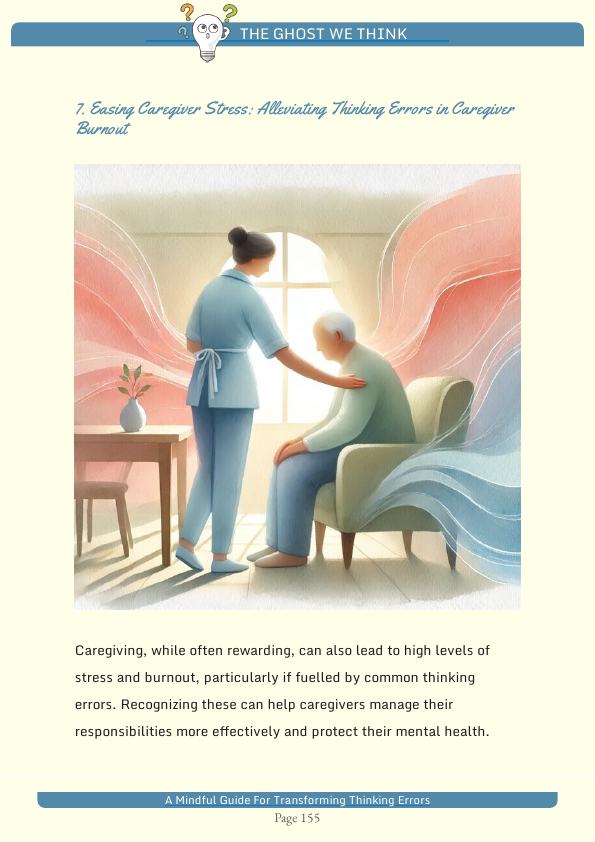
7. Easing Caregiver Stress: Alleviating Thinking Errors in Caregiver Burnout
Caregiving, while often rewarding, can also lead to high levels of stress and burnout, particularly if fuelled by common thinking errors. Recognizing these can help caregivers manage their responsibilities more effectively and protect their mental health.
1. Catastrophic Thinking or Fortune Telling
Definition: Anticipating the worst possible outcomes in caregiving situations. Example: Believing any small mistake in caregiving will have disastrous consequences. Solution: Focus on what you can control and recognize that not all situations lead to the worst outcomes. Practice mindfulness to stay present.
2. Discounting the Positive
Definition: Overlooking the successes and rewarding aspects of caregiving. Example: Ignoring the thankfulness expressed by the person you care for, focusing only on the burdens. Solution: Keep a gratitude journal to document positive moments and feedback, helping to balance your perspective.
3. Unfair Comparison
Definition: Comparing your caregiving situation to others, often idealizing their experiences. Example: Thinking other caregivers handle their responsibilities better or have it easier. Solution: Understand that each caregiving experience is unique, and avoid comparisons. Focus on your own journey.
4. Telepathy or Mind-Reading
Definition: Assuming you know what the person you are caring for or others think about your caregiving. Example: Believing that the person you care for is unhappy with your efforts without them indicating so. Solution: Communicate openly to understand the real thoughts and needs of those you care for and adjust your approach based on actual feedback.
5. Perfectionism
Definition: Believing that caregiving must be done perfectly to be effective. Example: Feeling inadequate because you can't meet every single need of the person you care for perfectly. Solution: Set realistic goals for caregiving and recognize that doing your best is enough. Allow room for mistakes and learning.
6. Overgeneralization or Labeling
Definition: Making broad, often negative conclusions based on a single event. Example: Concluding you're a bad caregiver because of one difficult day. Solution: Remind yourself that one challenging incident doesn’t define your entire caregiving capability. Reflect on other successful days.
7. Black or White Thinking
Definition: Seeing the caregiving role as completely good or bad, with no middle ground. Example: Feeling that you must either dedicate yourself entirely to caregiving or you have failed. Solution: Recognize and embrace the complexities and ups and downs in caregiving. It’s okay to have mixed feelings.
8. Personalization or Blaming
Definition: Taking personal responsibility for events beyond your control. Example: Blaming yourself for the health deterioration of the person you are caring for. Solution: Understand the limits of your control and influence. Share your feelings with a support group or therapist.
9. Emotional Reasoning
Definition: Allowing emotions to dictate your perception of your caregiving efficacy. Example: Feeling overwhelmed and thus concluding that the situation is hopeless. Solution: Seek practical support and use stress management techniques to handle emotional highs and lows. Evaluate the situation based on facts, not just feelings.
10. Mental Filter or Tunnel Vision
Definition: Focusing exclusively on the negatives or challenges in caregiving. Example: Dwelling only on what goes wrong, or what is exhausting, ignoring any moments of joy or satisfaction. Solution: Make an effort to notice and appreciate the positive aspects of caregiving. Regularly schedule time for self-care and activities you enjoy. By recognizing these thinking errors, caregivers can find more balance and satisfaction in their role, reducing the risk of burnout. It’s important to seek support when needed and remember that selfcare is not selfish—it’s essential.
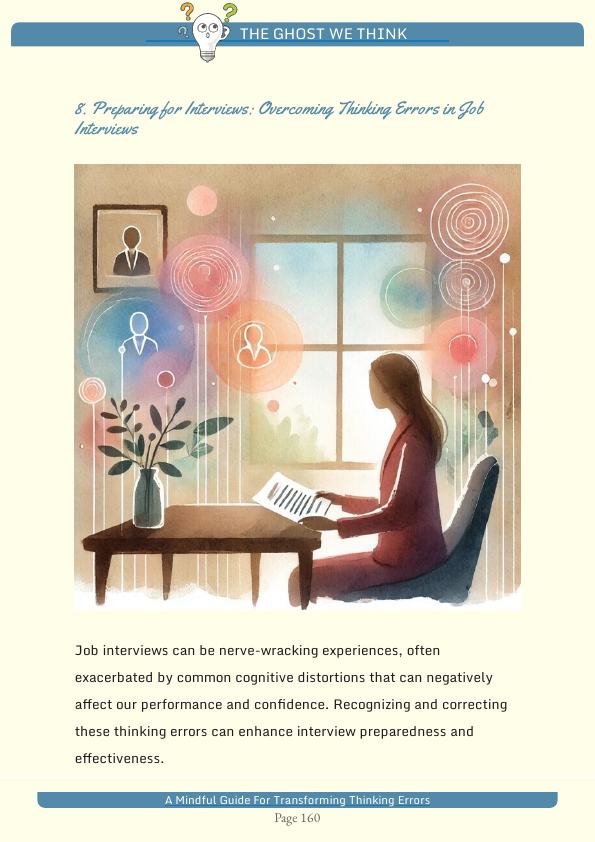
8. Preparing for Interviews: Overcoming Thinking Errors in Job Interviews
Job interviews can be nerve-wracking experiences, often exacerbated by common cognitive distortions that can negatively affect our performance and confidence. Recognizing and correcting these thinking errors can enhance interview preparedness and effectiveness.
1. Catastrophic Thinking or Fortune Telling
Definition: Expecting the worst-case scenario or predicting negative outcomes without evidence. Example: Believing you'll completely fail the interview if you stumble over a few words. Solution: Prepare thoroughly, but remember that minor mistakes are normal and often overlooked by interviewers. Stay focused on your strengths.
2. Discounting the Positive
Definition: Ignoring successful aspects of your interview performance and focusing solely on the minor negatives. Example: Fixating on one or two questions you felt unsure about, ignoring the ones you answered well. Solution: After the interview, write down what went well before you consider the areas for improvement. This helps create a balanced perspective.
3. Unfair Comparison
Definition: Comparing your abilities and performance unfavorably to others, often without complete information. Example: Assuming other candidates are more qualified and perform better in their interviews. Solution: Remember that you are being evaluated on your fit for the role, not against a hypothetical perfect candidate. Focus on presenting your own strengths.
4. Telepathy or Mind-Reading
Definition: Believing that you know what the interviewer is thinking, often negatively. Example: Assuming the interviewer thought your answers were inadequate. Solution: Avoid making assumptions about the interviewer's thoughts. Instead, focus on expressing your qualifications and suitability for the job.
5. Perfectionism
Definition: Believing that you must answer every question perfectly to succeed. Example: Feeling like you've failed the entire interview because of one imperfect answer. Solution: Aim to perform well overall rather than perfectly. Interviewers expect human responses, not robotic perfection.
6. Overgeneralization or Labeling
Definition: Making broad, often negative conclusions based on a single piece of evidence. Example: Labeling yourself as a poor communicator after fumbling a response. Solution: Treat each question as a new opportunity. One awkward moment doesn’t define your entire communication ability.
7. Black or White Thinking
Definition: Viewing the outcome of the interview in extreme terms. Example: Thinking you've either aced the interview or completely bombed it. Solution: Understand that most interview performances fall somewhere in the middle. Reflect objectively on both strengths and areas for improvement.
8. Personalization or Blaming
Definition: Taking full responsibility for negative interactions or outcomes, regardless of the circumstances. Example: Blaming yourself for not engaging the interviewer when they were actually distracted or disinterested. Solution: Recognize that you can only control your own actions and responses, not the interviewer’s mood or behavior.
9. Emotional Reasoning
Definition: Letting your feelings guide your assessment of the interview. Example: Feeling anxious and interpreting this as a sign you performed badly. Solution: Evaluate your performance based on facts, not emotions. Anxiety is a normal reaction and not a predictor of outcome.
10. Mental Filter or Tunnel Vision
Definition: Focusing exclusively on the negatives or failures, disregarding the positives. Example: Obsessing over the parts of the interview that didn't go as planned, ignoring the successful moments. Solution: Take a balanced view of the whole interview. Consider the effective responses you provided alongside any errors. By understanding and addressing these thinking errors, you can approach job interviews with a clearer, more confident mindset. Preparation, practice, and a balanced perspective are key to overcoming interview anxiety and achieving success.
9. Mastering Academic Tests: Resolving Thinking Errors in Exam Stress
Exams can be a significant source of stress for students of all ages. Stress often stems from distorted thinking patterns that exacerbate anxiety and can negatively impact performance. Recognizing and correcting these thinking errors can help you approach exams more calmly and confidently.
1. Catastrophic Thinking or Fortune Telling
Definition: Anticipating the worst possible outcomes, such as failing disastrously. Example: Believing that failing an exam will ruin your entire academic career or future. Solution: Focus on preparation and the steps you can take to succeed. Remember that one exam will not define your entire future.
2. Discounting the Positive
Definition: Minimizing your past successes and the effective aspects of your study habits. Example: Ignoring the exams you have done well on and focusing only on times you struggled. Solution: Keep a record of your study achievements and positive feedback, reviewing them to boost confidence before exams.
3. Unfair Comparison
Definition: Comparing your preparation or performance to others’ without considering their distinct circumstances. Example: Assuming classmates are better prepared or will perform better because they seem less stressed. Solution: Concentrate on your own studies and progress. Everyone prepares differently and has different strengths.
4. Telepathy or Mind-Reading
Definition: Assuming you know what your professors or peers think about your abilities. Example: Believing that your professor thinks you’re not smart because you asked questions in class. Solution: Remember that asking questions is a part of learning. Most educators view student inquiries as a sign of engagement and interest.
5. Perfectionism
Definition: Believing you must achieve a perfect score or that anything less is unacceptable. Example: Feeling like a failure if you don't score 100% on every test. Solution: Set realistic, achievable goals. Understand that perfection is not required for academic success.
6. Overgeneralization or Labeling
Definition: Drawing broad, often negative conclusions about your abilities based on a single outcome. Example: Labeling yourself as “terrible at math” because of one poor test result. Solution: View each exam as an isolated event and recognize that everyone has strengths and areas for improvement.
7. Black or White Thinking
Definition: Seeing your academic performance in absolutes: either perfect or a failure. Example: Believing that your entire exam was a disaster because of a few unsure answers. Solution: Evaluate your performance based on the overall effort and understanding, not just on specific uncertainties.
8. Personalization or Blaming
Definition: Taking personal blame for external factors beyond your control. Example: Blaming yourself for misunderstanding a question that was ambiguously worded. Solution: Recognize what is within your control (e.g., how well you prepare) and what isn't (e.g., the exam format or questions).
9. Emotional Reasoning
Definition: Allowing feelings of anxiety to convince you that you are unprepared or will perform poorly. Example: Feeling so nervous that you start believing you haven’t studied enough, despite being well-prepared. Solution: Ground your self-assessment in facts and evidence of your preparation, not just your emotions.
10. Mental Filter or Tunnel Vision
Definition: Focusing only on potential negatives or what could go wrong. Example: Dwelling only on the difficult parts of the study material, ignoring the parts you’ve mastered. Solution: Take a balanced view of your knowledge and preparation. Practice relaxation techniques to manage stress effectively. By identifying and adjusting these thinking errors, you can reduce exam stress and approach your studies and test days with a more balanced and positive outlook. Preparation, realistic goal-setting, and mental flexibility are your best tools for success.

10. Healing Post-Breakup: Navigating Thinking Errors After a Relationship Break-Off
The end of a relationship can trigger a range of intense emotions and thinking errors that complicate the healing process. Identifying and correcting these distortions can aid in recovery and personal growth.
1. Catastrophic Thinking or Fortune Telling
Definition: Anticipating the worst future scenarios as a result of the break-off. Example: Believing you will never find love again or be happy. Solution: Challenge these predictions by reminding yourself of your resilience and capacity for growth. The future holds many possibilities that are not defined by a past relationship.
2. Discounting the Positive
Definition: Ignoring the positive experiences and growth gained from the relationship. Example: Focusing only on the pain of the break-off and dismissing the good times and lessons learned. Solution: Acknowledge and appreciate the positive aspects and personal growth experienced during the relationship. This balanced view can foster healing.
3. Unfair Comparison
Definition: Comparing your emotional recovery to others or to societal expectations. Example: Feeling inadequate or weak because friends seem to recover more quickly from breakups. Solution: Understand that everyone heals at their own pace. Give yourself permission to grieve and heal in a way that suits you, without comparison.
4. Telepathy or Mind-Reading
Definition: Assuming you know what your ex-partner or others think about you post-breakup. Example: Believing your ex thinks negatively of you, or that others blame you for the breakup. Solution: Steer clear of assumptions about what others think. Focus on your own feelings and healing without the added weight of presumed judgments.
5. Perfectionism
Definition: Believing you must handle the breakup perfectly and show no signs of emotional distress. Example: Feeling like a failure for having moments of weakness or sadness. Solution: Allow yourself to experience a range of emotions. It’s normal and healthy to feel sad, angry, or confused. Embracing your emotional process is crucial for healing.
6. Overgeneralization or Labeling
Definition: Applying negative labels to yourself based on the breakup. Example: Concluding you're "unlovable" or "flawed" because the relationship ended. Solution: Remember that a relationship’s end does not define your worth or your capacity to be loved. Avoid broad labels and focus on understanding specific circumstances instead.
7. Black or White Thinking
Definition: Viewing the relationship as entirely good or bad based on how it ended. Example: Dismissing the entire relationship as a waste of time because it didn’t last. Solution: Recognize that relationships can provide value and learning opportunities, regardless of their duration.
8. Personalization or Blaming
Definition: Blaming yourself entirely for the breakup without considering external factors or mutual dynamics. Example: Taking full responsibility for the relationship’s issues and its end. Solution: Understand that relationships involve two people and that dynamics are complex. Reflect on your part without shouldering all the blame.
9. Emotional Reasoning
Definition: Letting your current feelings dictate your view of the relationship. Example: Feeling bitter and using that emotion to color the entire relationship negatively. Solution: Separate your emotions from the facts. Reflect on the relationship more holistically once emotions are not as intense.
10. Mental Filter or Tunnel Vision
Definition: Focusing solely on the negative aspects and outcomes of the relationship. Example: Remembering only the arguments and bad times, forgetting the moments of joy and connection. Solution: Make an effort to remember the relationship in its entirety, both good and bad. This can lead to a more balanced perspective and healthier recovery. Recognizing these thinking errors can help you navigate through the aftermath of a relationship break-off with greater clarity and resilience. Embrace your healing journey as a time for self-discovery and growth.
11. Overcoming Professional Setbacks: Tackling Thinking Errors in Therapist Perceptions
In the therapeutic process, not every session or intervention leads to the desired outcome. Both therapists and clients might sometimes perceive these as failures. Identifying and addressing thinking errors related to these perceived failures can improve resilience and effectiveness in therapy.
1. Catastrophic Thinking or Fortune Telling
Definition: Predicting irreversible negative outcomes from therapy setbacks. Example: A therapist might think, “I’ve failed this client completely,” after a session that didn’t go as planned. Solution: Recognize that therapy is a process with ups and downs. Reflect on what can be learned from the session and discuss it openly with the client.
2. Discounting the Positive
Definition: Ignoring successes and focusing only on what hasn’t worked. Example: Overlooking the progress a client has made because a recent therapy goal was not achieved. Solution: Keep a balanced view by documenting and reviewing both successes and challenges regularly.
3. Unfair Comparison
Definition: Comparing one's therapeutic methods or progress unfavorably to others’. Example: Believing other therapists always have successful outcomes with their clients. Solution: Understand that each therapist-client relationship is unique. Focus on individualized approaches rather than comparisons.
4. Telepathy or Mind-Reading
Definition: Assuming to know what a client or peer thinks without their explicit feedback. Example: Assuming a client thinks you are incompetent because they were quiet during a session. Solution: Encourage open communication and feedback to understand clients' thoughts and feelings accurately.
5. Perfectionism
Definition: Believing that perfect outcomes are the only indicators of successful therapy. Example: Feeling ineffective as a therapist if any client interaction is less than ideal. Solution: Set realistic expectations for therapy outcomes and recognize the value in the process itself.
6. Overgeneralization or Labeling
Definition: Drawing broad conclusions about one’s skills based on a single or few outcomes. Example: Labeling oneself a bad therapist after a few challenging sessions. Solution: Evaluate each situation individually and consider a wider range of experiences and feedback.
7. Black or White Thinking
Definition: Viewing therapy outcomes as either total successes or total failures. Example: Considering a therapy approach completely ineffective if it doesn’t work for one client. Solution: Acknowledge that different strategies may work differently with various clients. Adaptability is key.
8. Personalization or Blaming
Definition: Taking sole responsibility for the client’s progress or lack thereof. Example: Blaming oneself for a client’s slow progress without considering their external circumstances or readiness to change. Solution: Recognize the multifaceted nature of therapeutic progress, which often depends on factors beyond the therapist’s control.
9. Emotional Reasoning
Definition: Letting one’s feelings about a session determine its perceived success or failure. Example: Feeling discouraged after a difficult session and therefore viewing it as a failure. Solution: Base assessments on objective criteria and comprehensive understanding of the client’s journey, not just on emotional reactions.
10. Mental Filter or Tunnel Vision
Definition: Focusing exclusively on the negative aspects of therapy sessions. Example: Dwelling on what went wrong in a session while ignoring what went right. Solution: Endeavor to see each session as a composite of many factors. Regularly review all aspects to maintain a balanced perspective. Understanding and mitigating these thinking errors can significantly enhance the therapeutic process. It helps build a resilient therapeutic relationship that can withstand challenges and fosters growth for both the therapist and the client.

12. Enhancing Athletic Performance: Coping with Thinking Errors in Sports
Athletes of all levels can experience mental hurdles that impact their performance. Understanding and correcting these thinking errors can be crucial in achieving peak performance and maintaining a healthy, competitive mindset.
1. Catastrophic Thinking or Fortune Telling
Definition: Anticipating the worst possible outcomes without factual basis. Example: Before a game, thinking, “If I don’t score today, I’ll be cut from the team.” Solution: Focus on the process, not just outcomes. Set performance-based goals instead of outcome-based goals to stay motivated and positive.
2. Discounting the Positive
Definition: Overlooking successful aspects of performance and focusing solely on the negatives. Example: Ignoring a successful defensive play because you missed a shot earlier. Solution: Keep a performance journal to note both what went well and areas for improvement. Regularly review successes to maintain a balanced perspective.
3. Unfair Comparison
Definition: Comparing your abilities and achievements to others without considering differing circumstances. Example: Feeling inadequate because you’re not scoring as many goals as a teammate. Solution: Focus on personal bests and individual improvements. Everyone has unique strengths and weaknesses.
4. Telepathy or Mind-Reading
Definition: Assuming to know what coaches, teammates, or fans are thinking without their direct feedback. Example: Believing teammates think you’re the weakest link after a bad play. Solution: Communicate openly instead of making assumptions. Seeking feedback can provide clear, constructive information.
5. Perfectionism
Definition: Believing perfect performance is the only acceptable outcome. Example: Feeling like a failure for not achieving a personal best every game. Solution: Set realistic, achievable goals and recognize that progress is incremental. Celebrate small victories along the way.
6. Overgeneralization or Labeling
Definition: Making broad, often negative conclusions based on a single event. Example: Calling yourself “terrible” at a sport after one poor performance. Solution: Each game or event is just one part of a larger journey. Avoid defining your abilities by isolated incidents.
7. Black or White Thinking
Definition: Viewing performance and results in absolute terms, without recognizing any middle ground. Example: Seeing not winning as equivalent to failure. Solution: Understand that success in sports is often nuanced. Learning from losses can be as valuable as winning.
8. Personalization or Blaming
Definition: Taking personal responsibility for events beyond your control or blaming others for personal mistakes. Example: Blaming yourself for a team loss, disregarding the collective nature of sports. Solution: Recognize the team dynamics and that multiple factors contribute to outcomes. Share successes and failures.
9. Emotional Reasoning
Definition: Letting your feelings dictate your performance evaluation. Example: Feeling like you played poorly based on a few moments of self-doubt, despite a generally strong performance. Solution: Base your assessment on objective data (like stats and video analysis) rather than just feelings.
10. Mental Filter or Tunnel Vision
Definition: Focusing only on the negatives or a single aspect of performance. Example: Obsessing over missed opportunities in a game and overlooking successful strategies and execution. Solution: Endeavor to view each performance holistically. Recognize both strengths and areas for improvement. By understanding and addressing these thinking errors, athletes can enhance their mental toughness and overall performance. This balanced approach not only helps in achieving sporting goals but also supports a healthier psychological state.
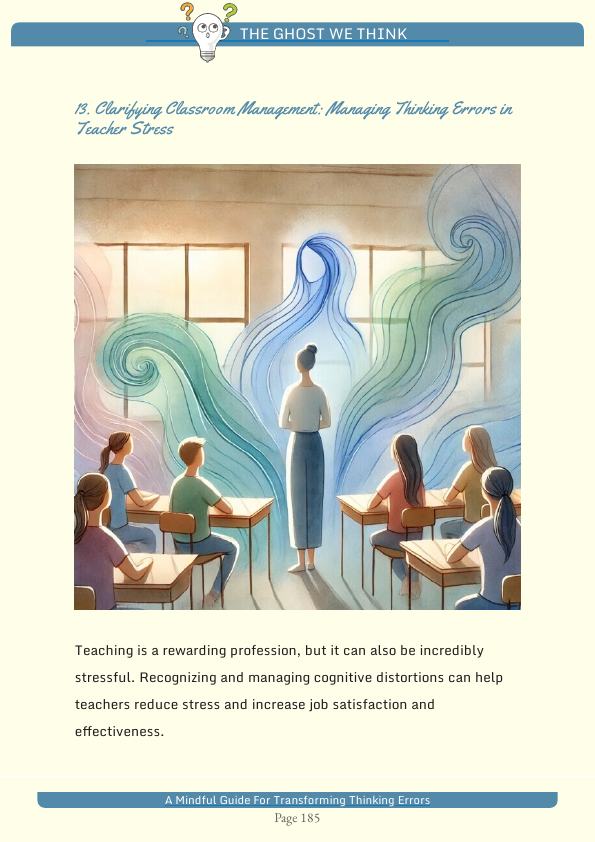
13. Clarifying Classroom Management: Managing Thinking Errors in Teacher Stress
Teaching is a rewarding profession, but it can also be incredibly stressful. Recognizing and managing cognitive distortions can help teachers reduce stress and increase job satisfaction and effectiveness.
1. Catastrophic Thinking or Fortune Telling
Definition: Anticipating the worst-case scenarios without factual basis. Example: Believing a single poor lesson could lead to job loss or thinking that a difficult class will ruin your entire school year. Solution: Reflect on past experiences where challenges were successfully navigated. Focus on what can be controlled and plan actionable steps for potential issues.
2. Discounting the Positive
Definition: Ignoring successes and positive feedback, focusing only on the negatives or failures. Example: Overlooking positive evaluations and compliments from students and peers because of one negative comment. Solution: Keep a 'success file' of positive feedback and achievements to review when feeling overwhelmed or discouraged.
3. Unfair Comparison
Definition: Comparing oneself unfavorably to other teachers without considering different contexts and resources. Example: Feeling inadequate because other teachers seem to have better classroom management or more engaged students. Solution: Acknowledge that each teacher has unique strengths and challenges. Focus on personal growth rather than comparison.
4. Telepathy or Mind-Reading
Definition: Assuming to know what others (students, parents, colleagues) think without their direct communication. Example: Believing that students find your classes boring or that colleagues think you're incompetent. Solution: Encourage open communication and feedback. Most people don’t express every thought, and these thoughts are often more positive than you assume.
5. Perfectionism
Definition: Believing that one must perform perfectly in all aspects of teaching. Example: Feeling like a failure if every lesson isn’t highly engaging or if all students don’t achieve high marks. Solution: Set realistic expectations and recognize that learning involves dealing with mistakes and setbacks. Strive for progress, not perfection.
6. Overgeneralization or Labeling
Definition: Making broad, negative conclusions based on single events. Example: Labeling yourself a bad teacher after a lesson that didn’t go as planned. Solution: View each teaching day as a separate opportunity. One bad day doesn’t define your entire career.
7. Black or White Thinking
Definition: Viewing teaching success or methods in absolute terms. Example: Believing that if a class isn’t completely under control, you are a complete failure. Solution: Accept that teaching often exists in a grey area. Embrace a flexible approach and adapt to the needs of your students.
8. Personalization or Blaming
Definition: Taking personal responsibility for every student's success or failure. Example: Feeling personally responsible if a student fails a test. Solution: Recognize that while teachers are significant influences, students’ performance is also affected by many factors outside your control.
9. Emotional Reasoning
Definition: Basing judgments of teaching performance on how you feel rather than objective evidence. Example: Feeling overwhelmed and concluding that your teaching is ineffective. Solution: Focus on concrete metrics like student progress over time rather than transient emotions. Seek peer support for a balanced perspective.
10. Mental Filter or Tunnel Vision
Definition: Focusing exclusively on the problematic aspects of teaching and ignoring the positives. Example: Dwelling only on the students who are struggling and overlooking those who are succeeding. Solution: Make an effort to notice and appreciate the positive aspects of teaching. Celebrate successes, however small they may seem. By addressing these thinking errors, teachers can develop a more balanced and resilient perspective towards their work, reducing stress and enhancing their professional and personal well-being.
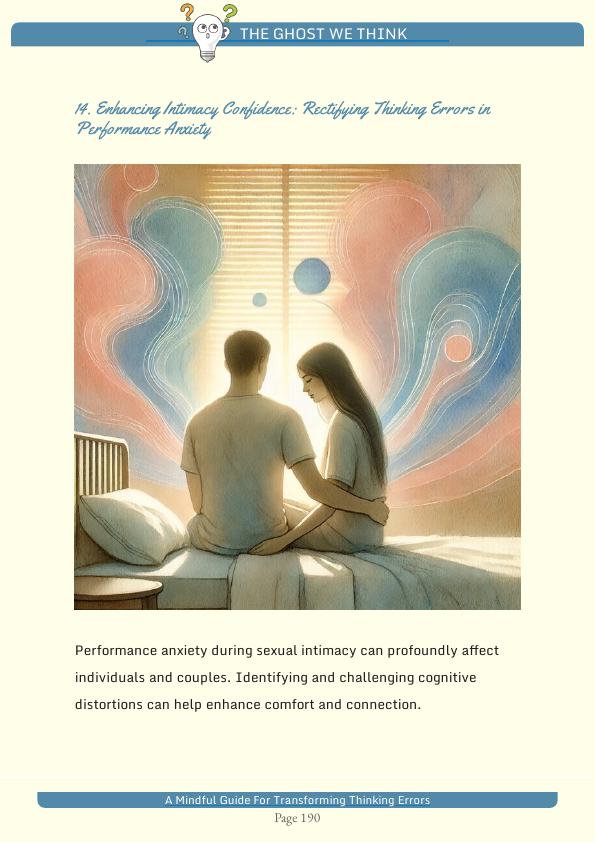
14. Enhancing Intimacy Confidence: Rectifying Thinking Errors in Performance Anxiety
Performance anxiety during sexual intimacy can profoundly affect individuals and couples. Identifying and challenging cognitive distortions can help enhance comfort and connection.
1. Catastrophic Thinking or Fortune Telling
Definition: Anticipating the worst possible outcomes, such as failure to satisfy a partner or fear of impotence. Example: Believing that one instance of poor performance will ruin your sexual relationship permanently. Solution: Focus on the present moment rather than future fears. Engage in mindfulness practices to stay connected to your body and the experience.
2. Discounting the Positive
Definition: Ignoring previous successful sexual encounters and focusing solely on any negatives. Example: Overlooking instances of mutual satisfaction because of one awkward moment. Solution: Keep a mental or written list of positive sexual experiences and affirmations to counterbalance negative thoughts.
3. Unfair Comparison
Definition: Comparing your sexual performance or experiences to others’, often without a realistic basis. Example: Feeling inadequate after comparing oneself to unrealistic portrayals of sexuality in media or pornography. Solution: Recognize that each individual and couple has unique dynamics and strengths. Avoid comparisons and focus on what makes your relationship special.
4. Telepathy or Mind-Reading
Definition: Assuming you know what your partner is thinking or feeling without their input. Example: Believing your partner is dissatisfied without having a conversation about it. Solution: Communicate openly with your partner about your feelings and desires. Encourage them to share theirs to foster understanding and closeness.
5. Perfectionism
Definition: Believing that sexual encounters must be perfect to be satisfying. Example: Feeling that every aspect of a sexual encounter must go flawlessly, or it’s a failure. Solution: Accept that real-life intimacy involves imperfections and spontaneity. Focus on the connection and pleasure shared, rather than a perfect performance.
6. Overgeneralization or Labeling
Definition: Applying broad, often negative labels to oneself based on a single or few sexual experiences. Example: Labeling oneself as unattractive or inadequate after not performing as expected. Solution: Challenge these labels by looking at a more comprehensive history of your sexual experiences and relationships.
7. Black or White Thinking
Definition: Viewing sexual performance and relationships in absolute terms. Example: Thinking you are either a great lover or a terrible one, based on limited experiences. Solution: Embrace a more nuanced view of sexual performance that includes many factors and moments, not just a binary evaluation.
8. Personalization or Blaming
Definition: Taking sole responsibility for any issues in sexual intimacy. Example: Assuming all responsibility for a partner’s sexual satisfaction or any dysfunctions. Solution: Acknowledge that sexual dynamics involve both partners. Discuss ways you can work together to improve intimacy.
9. Emotional Reasoning
Definition: Letting feelings of anxiety or inadequacy dictate your perceived sexual competence. Example: Feeling anxious and therefore concluding you are sexually incompetent. Solution: Identify emotions as they arise and challenge them by checking facts with your partner and reflecting on past experiences positively.
10. Mental Filter or Tunnel Vision
Definition: Focusing solely on what went wrong or could go wrong, ignoring the positive or successful aspects. Example: Obsessing over a moment of awkwardness and not recognizing the overall enjoyable experience. Solution: Strive for a balanced view of your sexual experiences. Focus on and cultivate positive interactions and communications. By recognizing and addressing these cognitive distortions, individuals can reduce performance anxiety and foster a more satisfying and intimate relationship. Open communication and mutual understanding are key elements in this process.
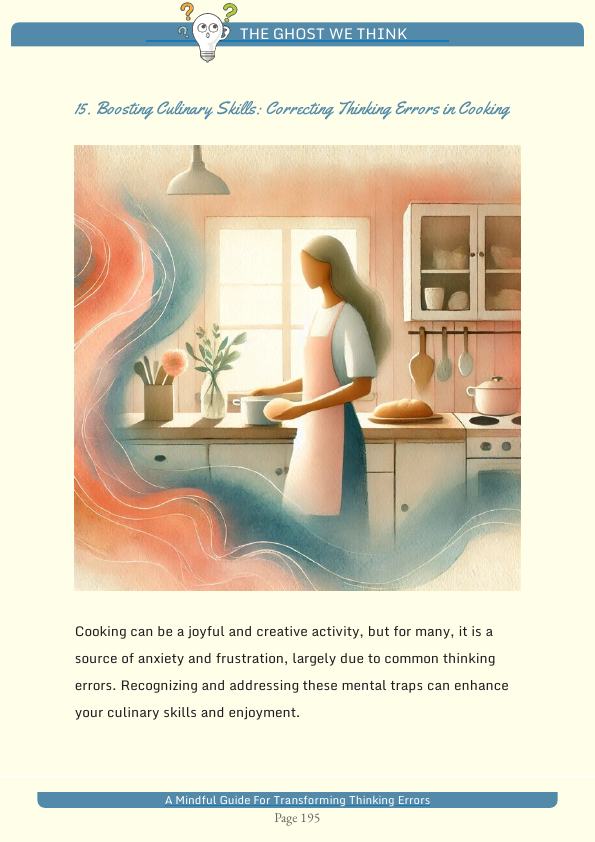
15. Boosting Culinary Skills: Correcting Thinking Errors in Cooking
Cooking can be a joyful and creative activity, but for many, it is a source of anxiety and frustration, largely due to common thinking errors. Recognizing and addressing these mental traps can enhance your culinary skills and enjoyment.
1. Catastrophic Thinking or Fortune Telling
Definition: Predicting the worst outcomes in the kitchen without any real evidence. Example: Believing a meal will be a total disaster if one ingredient is missing or slightly burnt. Solution: Focus on solutions and alternatives rather than what might go wrong. Cooking is often about improvisation and making do with what you have.
2. Discounting the Positive
Definition: Ignoring successful aspects of your cooking and focusing only on minor mishaps. Example: Overlooking a well-executed dish because one component didn’t meet your expectations. Solution: Take a moment to acknowledge what went well in the kitchen. Celebrate the successes, no matter how small.
3. Unfair Comparison
Definition: Comparing your culinary skills or dishes unfavorably to those of others, especially professional chefs or more experienced cooks. Example: Feeling inadequate after scrolling through perfect food pictures on social media. Solution: Remember that everyone starts somewhere, and every cook has had their fair share of kitchen failures. Focus on improving your skills at your own pace.
4. Telepathy or Mind-Reading
Definition: Assuming you know what others think of your cooking without their feedback. Example: Believing guests didn’t enjoy the meal because they didn’t say it was delicious. Solution: Avoid assumptions and ask for feedback directly. Most people appreciate the effort and enjoy the food more than you might think.
5. Perfectionism
Definition: Believing that your dishes must come out perfectly every time. Example: Feeling frustrated and giving up on cooking a dish because it doesn’t look exactly as it does in the recipe book. Solution: Embrace the learning process of cooking. Each mistake is an opportunity to learn and improve.
6. Overgeneralization or Labeling
Definition: Drawing broad, negative conclusions about your cooking abilities based on one bad experience. Example: Thinking you’re bad at cooking because you ruined one meal. Solution: Recognize that one mishap does not define your cooking skills. Reflect on other times you’ve successfully prepared meals.
7. Black or White Thinking
Definition: Viewing your cooking skills in absolute terms. Example: Believing that if a dish isn’t perfect, it’s a complete failure. Solution: Understand that cooking is an art with many gray areas. Meals can still be delicious even if they’re not perfect.
8. Personalization or Blaming
Definition: Blaming yourself entirely for culinary mishaps, without considering other factors. Example: Blaming yourself for a dinner party failure because the dessert didn’t set, ignoring other factors like oven variability or ingredient quality. Solution: Consider external factors that may have influenced the cooking outcome and recognize that not everything is within your control.
9. Emotional Reasoning
Definition: Letting your emotions about cooking influence your perception of your abilities. Example: Feeling anxious about cooking and thus concluding that you must be terrible at it. Solution: Separate feelings from facts. Just because you feel a certain way doesn’t mean it reflects your true ability or the outcome.
10. Mental Filter or Tunnel Vision
Definition: Focusing solely on what went wrong, ignoring what went right. Example: Dwelling on the fact that the rice was overcooked, not noticing that everyone loved the main dish. Solution: Try to view the overall meal and the experience as a whole, rather than fixating on individual aspects. By recognizing and adjusting these thinking errors, you can build confidence in the kitchen and find more joy in cooking. Remember, every chef started somewhere, and every meal is a chance to learn something new. Enjoy the process, and the results will follow.
16. Building Driving Confidence: Addressing Thinking Errors in Driving Skills
Lack of confidence while driving can significantly impact a person's ability to operate a vehicle safely and comfortably. Many of these feelings stem from cognitive distortions that skew perceptions of driving abilities and situations. Correcting these thinking errors can help build confidence and make driving a more positive experience.
1. Catastrophic Thinking or Fortune Telling
Definition: Anticipating the worst possible outcomes when behind the wheel. Example: Believing that every mistake could lead to a major accident or fearing disastrous consequences in routine driving situations. Solution: Challenge these thoughts by examining the actual statistics of driving incidents and recognize the effectiveness of safe driving practices and vehicle safety features.
2. Discounting the Positive
Definition: Ignoring instances of successful driving experiences and focusing only on the negatives or the times when you felt unsure. Example: Not acknowledging a well-handled drive because you felt anxious at one point. Solution: Keep a driving log where you note successful trips and positive details, like smooth lane changes or confident navigation.
3. Unfair Comparison
Definition: Comparing your driving skills to others who are more experienced, without considering their years of practice. Example: Feeling inadequate because you are not as smooth in traffic as a friend who has been driving for many more years. Solution: Recognize that driving skills improve with time and practice. Focus on your own progress and set personal milestones.
4. Telepathy or Mind-Reading
Definition: Believing you know what other drivers are thinking about your driving skills. Example: Assuming that other drivers are judging you for being too slow or making minor errors. Solution: Remember that most drivers are more focused on their own journey than on critiquing others. Concentrate on the road and your actions.
5. Perfectionism
Definition: Believing that you must drive perfectly at all times. Example: Feeling like a failure if you make any small mistake, such as a slightly jerky stop. Solution: Accept that all drivers make mistakes and that it is a normal part of driving. Focus on learning from each experience rather than being flawless.
6. Overgeneralization or Labeling
Definition: Making broad, negative conclusions based on a single or few driving experiences. Example: Thinking of yourself as a bad driver after a couple of difficult drives. Solution: View each driving experience as an isolated event and remember that practice will lead to improvement.
7. Black or White Thinking
Definition: Seeing your driving ability in absolute terms. Example: Believing that you are either a good driver or a terrible one, with no in-between. Solution: Understand that driving skills exist on a spectrum and can always be improved with effort and education.
8. Personalization or Blaming
Definition: Taking responsibility for things out of your control or blaming yourself for every problem on the road. Example: Feeling guilty about causing traffic delays when you drive cautiously in bad weather. Solution: Acknowledge that you are one of many on the road and that traffic is a collective issue influenced by many factors.
9. Emotional Reasoning
Definition: Assuming your nervous feelings reflect the truth about your driving skills. Example: Feeling anxious every time you drive and concluding that this means you are not skilled at driving. Solution: Separate feelings from facts. Use nervous energy as a cue to practice more and gain comfort, rather than as evidence of incompetence.
10. Mental Filter or Tunnel Vision
Definition: Focusing only on the negatives or the risks of driving. Example: Constantly thinking about what could go wrong instead of noticing what you are doing right. Solution: Practice mindfulness to stay present and focused while driving. Celebrate what you handle well during each drive. By addressing these thinking errors, you can gradually build confidence in your driving abilities. It’s important to approach driving as a skill that requires practice and patience, allowing yourself to learn from each experience without undue stress.

17. Correcting Nursing Practices: Examining Thinking Errors After Medication Errors
Medication errors can occur in nursing and can be distressing for both the healthcare professionals involved and their patients. Understanding the thinking errors that often follow such mistakes can help nurses cope more effectively and prevent future errors.
1. Catastrophic Thinking or Fortune Telling
Definition: Predicting the worst possible consequences from a medication error without considering potential interventions or mitigating factors. Example: Believing that a single medication error will inevitably lead to severe patient harm or the end of one's nursing career. Solution: Focus on immediate steps to manage the situation effectively. Engage in fact-based risk assessment and follow protocols to mitigate harm.
2. Discounting the Positive
Definition: Ignoring or minimizing the correct decisions and actions taken during one's nursing practice because of focusing solely on the error. Example: Overlooking years of error-free practice and the successful administration of medications due to one mistake. Solution: Maintain a balanced view by documenting and reflecting on both successes and areas for improvement regularly.
3. Unfair Comparison
Definition: Comparing oneself unfavorably to other nurses who have not made similar errors, or assuming they do not make mistakes. Example: Feeling like the only nurse who has ever made a medication error. Solution: Recognize that all humans are fallible, and medication errors are common across all levels of experience. Sharing and discussing errors can normalize them as opportunities for learning.
4. Telepathy or Mind-Reading
Definition: Assuming to know what others—colleagues, patients, supervisors—think about you after the error. Example: Believing that everyone thinks you are a careless or incompetent nurse because of the mistake. Solution: Communicate openly with your colleagues and supervisors about the incident. Seek feedback and support instead of assuming negative judgments.
5. Perfectionism
Definition: Believing that perfect practice is the only acceptable standard and that any error is a catastrophic failure. Example: Feeling like a total failure and considering leaving nursing after making a medication error. Solution: Set realistic expectations for human performance, including the possibility of errors. Embrace a culture of safety that allows for open discussion of mistakes to foster improvement.
6. Overgeneralization or Labeling
Definition: Applying a general rule based on a single incident and labeling oneself negatively. Example: Labeling oneself as a "bad nurse" after a medication error. Solution: Understand that one error does not define your entire professional capability or character. Assess the specific circumstances of the error to learn and grow.
7. Black or White Thinking
Definition: Viewing the error as either completely disastrous or completely benign, without recognizing the nuances. Example: Thinking that because the error didn’t cause immediate harm, it’s unimportant. Solution: Acknowledge the seriousness of medication errors but also recognize the degrees of impact and potential for constructive outcomes through proper response and system improvement.
8. Personalization or Blaming
Definition: Taking personal responsibility for systemic failures or, conversely, blaming others entirely for the mistake. Example: Blaming oneself entirely without considering factors like staffing levels, work environment, or systemic issues. Solution: Consider all factors that contributed to the error, including systemic and procedural factors. Work collaboratively to address these issues.
9. Emotional Reasoning
Definition: Letting feelings of guilt or anxiety dictate your perception of your professional competence. Example: Feeling anxious every time you administer medication post-error and questioning your skills. Solution: Separate emotions from objective assessments of skill and safety. Continue to engage in professional development and support.
10. Mental Filter or Tunnel Vision
Definition: Focusing solely on the negative aspects of one’s practice and ignoring the positive contributions and improvements. Example: Dwelling only on the mistake rather than acknowledging the numerous times when your actions have positively impacted patient care. Solution: Make an effort to view your professional practice in its entirety, acknowledging both strengths and areas for improvement. By addressing these thinking errors, nurses can better cope with the stress of medication errors, learn from these incidents, and continue to provide high-quality care. Remember, fostering an environment where errors can be openly discussed and learned from is key to improving patient safety and nursing
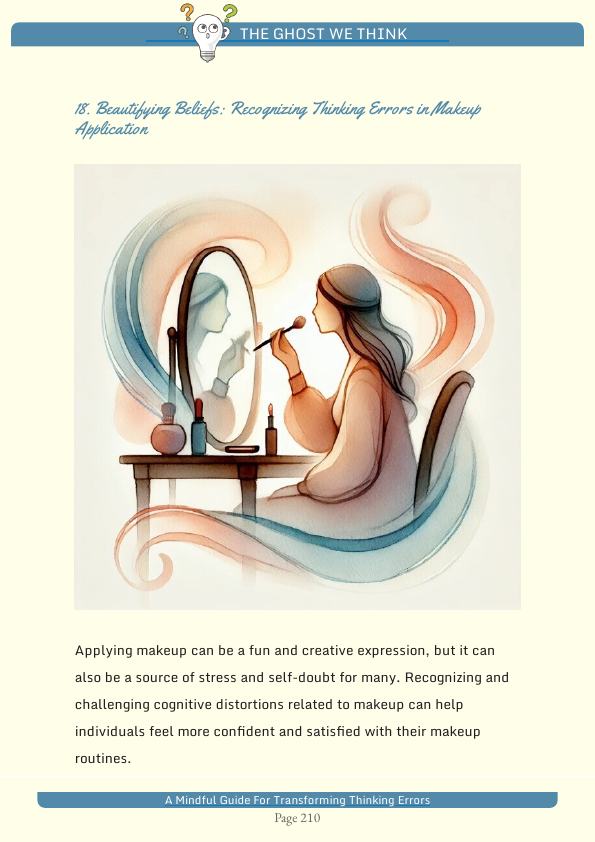
18. Beautifying Beliefs: Recognizing Thinking Errors in Makeup Application
Applying makeup can be a fun and creative expression, but it can also be a source of stress and self-doubt for many. Recognizing and challenging cognitive distortions related to makeup can help individuals feel more confident and satisfied with their makeup routines.
1. Catastrophic Thinking or Fortune Telling
Definition: Expecting the worst outcomes from your makeup efforts, such as believing a small mistake will ruin your entire look. Example: Thinking that if your eyeliner isn’t perfectly symmetrical, it will be the only thing people notice. Solution: Recognize that small imperfections are normal and often go unnoticed by others. Embrace a more relaxed approach where minor flaws are not viewed as disasters.
2. Discounting the Positive
Definition: Overlooking what you’ve done well with your makeup by focusing only on what you perceive as mistakes. Example: Ignoring a beautifully applied lipstick because you're unhappy with how your eyeshadow turned out. Solution: Make a conscious effort to acknowledge and appreciate what you like about your makeup each time you apply it.
3. Unfair Comparison
Definition: Comparing your makeup skills or the products you use unfavorably to those of professional makeup artists or celebrities. Example: Feeling inadequate because your makeup doesn’t look like what you see on social media or in magazines. Solution: Remember that images in media are often enhanced and retouched. Focus on developing your own style and skills at a pace that suits you.
4. Telepathy or Mind-Reading
Definition: Assuming you know what others think about your makeup without any real feedback. Example: Believing that others think your makeup looks amateurish or too bold. Solution: Avoid making assumptions about others’ opinions. If you’re curious or need reassurance, consider asking a trusted friend for their honest opinion.
5. Perfectionism
Definition: Believing your makeup must be perfect to be acceptable. Example: Feeling the need to spend hours achieving the perfect contour or highlight. Solution: Set realistic goals for your makeup, such as aiming for a look that makes you feel good rather than one that meets unrealistically high standards.
6. Overgeneralization or Labeling
Definition: Drawing broad, negative conclusions about your abilities based on one or a few makeup experiences. Example: Thinking you’re terrible at doing makeup because of one time when your foundation looked patchy. Solution: View each makeup application as a learning opportunity. Remember that practice improves skills over time.
7. Black or White Thinking
Definition: Seeing your makeup skills in absolute terms—either perfect or a failure. Example: Deciding that your makeup is a total failure if one element doesn’t meet your expectations. Solution: Appreciate the effort and creativity involved in the process. Understand that a few small imperfections don’t define the overall quality of your makeup.
8. Personalization or Blaming
Definition: Blaming yourself entirely for makeup outcomes influenced by factors beyond your control. Example: Blaming yourself for makeup melting off on a hot day. Solution: Recognize the external factors like weather, skin condition, or product formulations that affect your makeup and adjust your routine accordingly.
9. Emotional Reasoning
Definition: Allowing your feelings about your appearance to shape your view of your makeup skills. Example: Feeling unattractive and concluding that it’s because your makeup skills are poor. Solution: Separate feelings about your self-image from your makeup application. Focus on using makeup as a tool to enhance how you feel, not a measure of your worth.
10. Mental Filter or Tunnel Vision
Definition: Focusing only on the aspects of your makeup that you dislike while ignoring what you’ve accomplished. Example: Dwelling on your imperfect winged eyeliner and not noticing your flawlessly applied foundation. Solution: Try to view your makeup holistically. Celebrate what you’ve achieved and lightly note what you might want to improve next time without judgment. By recognizing and addressing these thinking errors, you can make the process of applying makeup more enjoyable and fulfilling. Remember, makeup is an art form where personal expression and creativity should be encouraged and celebrated.
19. Balancing Work: Understanding Thinking Errors in Work-Life Balance
Achieving a healthy work-life balance is a common challenge that can significantly affect personal satisfaction and productivity. Cognitive distortions can distort how we manage and perceive our obligations in both domains. Addressing these thinking errors is key to establishing a more fulfilling balance.
1. Catastrophic Thinking or Fortune Telling
Definition: Predicting the worst possible outcomes if work and personal life aren’t perfectly balanced. Example: Believing that any misstep at work will lead to job loss or assuming a single missed family event will cause lasting relationship damage. Solution: Consider realistic outcomes and use flexible planning to handle work and personal life demands more adaptively.
2. Discounting the Positive
Definition: Ignoring successful balancing efforts and focusing only on the times when work or personal life feels overwhelming. Example: Overlooking a week of leaving work on time to manage personal responsibilities because of one late evening. Solution: Keep a record of successful balance efforts and regularly review them to maintain a positive perspective on your efforts.
3. Unfair Comparison
Definition: Comparing your work-life balance to others’ without full knowledge of their circumstances. Example: Feeling inadequate because colleagues seem to manage work and family commitments more smoothly. Solution: Understand that each person’s work-life balance is influenced by unique factors and focus on finding what works best for you.
4. Telepathy or Mind-Reading
Definition: Assuming to know what coworkers or family members think about your work-life balance decisions. Example: Believing that your boss thinks you're not dedicated because you prioritize leaving on time for family activities. Solution: Communicate openly about your work-life balance needs and seek actual feedback instead of assuming negative judgments.
5. Perfectionism
Definition: Believing that achieving a perfect balance is the only acceptable outcome. Example: Feeling like a failure if any aspect of work or personal life is not handled perfectly. Solution: Embrace a flexible approach to work-life balance, recognizing that some days will be more work-focused and others more personal-life-focused.
6. Overgeneralization or Labeling
Definition: Making broad, negative conclusions about your balancing capabilities from a single or few instances. Example: Labeling yourself as incompetent at managing worklife balance after a particularly stressful week. Solution: View each instance as an opportunity to learn and adjust your strategies, knowing that balance can fluctuate.
7. Black or White Thinking
Definition: Viewing your ability to balance work and life in absolute terms. Example: Seeing yourself as either having a perfect balance or a complete failure at managing work and life. Solution: Recognize the continuum of work-life balance and appreciate gradual improvements and efforts.
8
. Personalization or Blaming
Definition: Taking personal responsibility for every work-life conflict or blaming others for all balance issues. Example: Blaming yourself entirely for missing a family event due to work demands. Solution: Analyze situations objectively to understand all factors involved and share responsibilities appropriately.
9. Emotional Reasoning
Definition: Basing your assessment of your work-life balance on how you feel rather than on objective measurements. Example: Feeling overwhelmed and concluding your work-life balance is poor. Solution: Use concrete metrics like time spent at work and at home to make informed assessments rather than relying solely on emotional states.
10. Mental Filter or Tunnel Vision
Definition: Focusing only on the negatives of work or personal life, ignoring successes in balancing both. Example: Dwelling on a missed weekend activity due to work and not acknowledging the many successful outings. Solution: Endeavor to recognize and celebrate both work achievements and personal life joys to foster a more balanced view. By recognizing and adjusting these thinking errors, individuals can better manage their work and personal lives, leading to increased satisfaction and effectiveness in both areas. This approach supports a healthier, more balanced lifestyle.
20. Improving Financial Health: Navigating Thinking Errors in Personal Finance
Managing personal finances is often accompanied by anxiety and fear, especially when faced with debt, savings goals, or investment decisions. These feelings can be intensified by cognitive distortions that skew our perceptions of financial health and decision-making capabilities. Here, we address common thinking errors related to personal finance and offer strategies for more rational thinking.
1. Catastrophic Thinking or Fortune Telling
Definition: Predicting the worst financial outcomes without any factual basis. Example: Fearing that a single budgeting mistake will lead to financial ruin. Solution: Focus on the overall trends in your financial activities rather than isolated incidents, and use realistic planning to mitigate risks.
2. Discounting the Positive
Definition: Ignoring or undervaluing your financial achievements and capabilities. Example: Overlooking the progress in building your savings due to concerns about debt. Solution: Keep a record of financial milestones and positive steps taken, however small, to reinforce a balanced view of your financial health.
3. Unfair Comparison
Definition: Comparing your financial status or progress unfavorably against others without considering differences in circumstances. Example: Feeling inadequate because friends seem to afford more luxurious lifestyles. Solution: Understand that each financial journey is unique and influenced by various personal factors. Focus on setting and achieving your own financial goals.
4. Telepathy or Mind-Reading
Definition: Assuming to know how others judge your financial status. Example: Believing others think less of you because you don’t drive a newer car. Solution: Avoid assumptions about others’ perceptions and concentrate on making financial decisions that align with your values and needs.
5. Perfectionism
Definition: Believing that you must manage your finances flawlessly to be financially secure. Example: Feeling like a failure for having any debt, even if it's manageable and strategically incurred. Solution: Set realistic financial goals and recognize that managing finances well does not mean managing them perfectly.
6. Overgeneralization or Labeling
Definition: Applying broad, negative labels to yourself based on your financial mistakes. Example: Thinking of yourself as irresponsible after making a late payment. Solution: Treat financial errors as learning opportunities rather than defining traits, and implement strategies to prevent similar mistakes in the future.
7. Black or White Thinking
Definition: Viewing financial decisions as either completely good or bad, without considering the nuances. Example: Seeing all debt as bad, regardless of its purpose or terms. Solution: Recognize the complexity of financial decisions. Some debts, like mortgages or student loans, can be part of a wellconsidered financial plan.
8. Personalization or Blaming
Definition: Taking personal blame for global or external financial events. Example: Blaming yourself for investment losses during a market downturn. Solution: Distinguish between factors within your control and broader economic conditions. Focus on long-term planning and adaptation strategies.
9. Emotional Reasoning
Definition: Letting feelings of anxiety or stress dictate your perceptions of your financial health. Example: Feeling overwhelmed and assuming it means your financial situation is dire. Solution: Base financial decisions on objective data and planned financial strategies rather than on fluctuating emotions.
10. Mental Filter or Tunnel Vision
Definition: Focusing exclusively on the negatives or potential risks in your financial situation. Example: Constantly worrying about the possibility of future financial problems and ignoring current financial stability. Solution: Endeavor to acknowledge both the strengths and weaknesses in your financial situation, maintaining a balanced perspective that includes positive developments. By understanding and addressing these thinking errors, individuals can approach personal finance management with greater clarity and confidence. This can lead to more informed decisions, reduced anxiety, and ultimately, a healthier financial life.

21. Engaging in Social Interactions: Alleviating Thinking Errors in Social Anxiety
Social interactions can be enriching, but they can also lead to anxiety and insecurity due to common cognitive distortions. Recognizing and challenging these distortions can help individuals feel more confident and relaxed in social settings.
1. Catastrophic Thinking or Fortune Telling
Definition: Expecting the worst outcomes from social interactions, such as fearing extreme rejection or humiliation. Example: Worrying that saying something slightly awkward will make you a social outcast. Solution: Recognize that social mishaps are common and often quickly forgotten. Embrace a more forgiving approach where minor blunders are seen as normal.
2. Discounting the Positive
Definition: Overlooking successful social interactions by focusing only on perceived shortcomings. Example: Ignoring an evening of engaging conversations because of one moment of silence. Solution: Actively acknowledge and value positive feedback and successful interactions to counterbalance any negative thoughts.
3. Unfair Comparison
Definition: Comparing your social skills or interactions unfavorably to those of others, often without knowing their full story. Example: Feeling less interesting because your stories aren't as dramatic as those of a friend. Solution: Understand that everyone has different strengths in social settings; focus on your unique qualities and interactions.
4. Telepathy or Mind-Reading
Definition: Assuming you know what others are thinking about you during social interactions. Example: Believing that others think you're boring because they didn't laugh at your joke. Solution: Avoid assumptions and engage more directly to gauge others' reactions, or ask open-ended questions to clarify their thoughts.
5. Perfectionism
Definition: Believing that you must perform perfectly in social settings to be accepted. Example: Feeling the need to always say the right thing at the right time. Solution: Set realistic social goals, such as being present and genuine, rather than trying to meet an idealized standard of perfection.
6. Overgeneralization or Labeling
Definition: Drawing broad, negative conclusions about your social abilities based on a limited set of interactions. Example: Labeling yourself as socially awkward after one or two less-than-ideal encounters. Solution: View each social interaction as a separate experience and remember that social skills improve with practice and exposure.
7. Black or White Thinking
Definition: Viewing social skills in absolute terms—either perfect or disastrous. Example: Thinking you're a social failure if not everyone responds positively to you. Solution: Appreciate the nuances in social interactions. Not every encounter has to be flawless to be considered successful.
8. Personalization or Blaming
Definition: Blaming yourself entirely for the outcome of social interactions, ignoring other factors. Example: Blaming yourself for a party being dull, regardless of other dynamics at play. Solution: Recognize that social dynamics involve multiple factors and participants, and you control only your part.
9. Emotional Reasoning
Definition: Believing that because you feel a certain way, it must reflect the reality of the social situation. Example: Feeling anxious and concluding that the social interaction is going poorly. Solution: Separate your feelings from the actual events. Just because you feel anxious doesn't mean the situation is negative.
10. Mental Filter or Tunnel Vision
Definition: Focusing exclusively on the negatives of social interactions and ignoring the positives. Example: Dwelling only on a moment when you felt left out, rather than remembering times you were engaged. Solution: Try to view your social interactions holistically. Celebrate the connections you make and learn from the moments that didn't go as planned. By understanding and addressing these thinking errors, individuals can navigate social situations with more assurance and less anxiety, enhancing overall social satisfaction and engagement.

22. Navigating Recovery: Addressing Thinking Errors in Cancer Treatment & Fear of Relapse
Managing thoughts and emotions is crucial in coping with cancer treatment and the fear of relapse. Here’s how to address common cognitive distortions that may arise:
Catastrophic Thinking or Fortune Telling:
Definition: Expecting the worst outcomes, such as fearing immediate relapse. Example: Believing any minor symptom is a sign of returning cancer. Solution: Focus on the present and facts from your medical team rather than fearing what might happen.
Discounting the Positive:
Definition: Overlooking significant recovery milestones by focusing solely on the risks of relapse. Example: Ignoring your progress and good health days, focusing only on the fear of cancer returning. Solution: Keep a health diary to track recovery progress and positive medical feedback, reinforcing the successful aspects of your treatment.
Unfair Comparison:
Definition: Comparing your recovery to others, perhaps thinking they are doing better or worse without knowing all the details. Example: Feeling your recovery is inadequate compared to others in your support group who seem to be doing better. Solution: Understand that each person’s recovery and treatment response is unique. Focus on your personal health journey.
Telepathy or Mind-Reading:
Definition: Assuming you know what others think about your health situation. Example: Believing others see you only as a patient or a survivor, without considering their perspective. Solution: Communicate openly with family and friends about your feelings and needs, and allow them to share theirs.
Perfectionism:
Definition: Believing you must handle everything perfectly, including managing all aspects of treatment and recovery without struggle. Example: Feeling inadequate for experiencing days of low energy or mood. Solution: Set realistic expectations for recovery and recognize that ups and downs are normal.
Overgeneralization or Labeling:
Definition: Drawing broad, negative conclusions about your health based on a single event. Example: Thinking of yourself as permanently unwell after a day of feeling symptoms. Solution: Treat each day as a separate experience, knowing that fluctuations are part of recovery.
Black or White Thinking:
Definition: Viewing your recovery as either entirely successful or a total failure. Example: Believing your treatment is a failure if you experience any setbacks. Solution: Acknowledge the complexity of cancer recovery; not every tough day means treatment failure.
Personalization or Blaming:
Definition: Blaming yourself for aspects of the illness or recovery that are beyond personal control. Example: Feeling guilty for having cancer or not recovering ‘quickly enough’. Solution: Understand that many factors influence recovery and disease, many of which are not under personal control.
Emotional Reasoning:
Definition: Believing that because you feel a certain way, it must be true. Example: Feeling scared and concluding that a relapse is imminent. Solution: Base your outlook on medical advice and actual health checks rather than emotions alone.
Mental Filter or Tunnel Vision:
Definition: Focusing only on potential negative outcomes or past health issues. Example: Dwelling on the possibilities of cancer recurrence and ignoring current health improvements. Solution: Focus on current health achievements and live in the present. Practice mindfulness to maintain a balanced perspective on your health journey. By understanding and adjusting these thinking errors, you can approach your recovery with a more balanced mindset, reducing anxiety and fostering a positive outlook on your health.
Summary
Feel free to write down any after-reading insights and thoughts. After reading this, I feel right now...
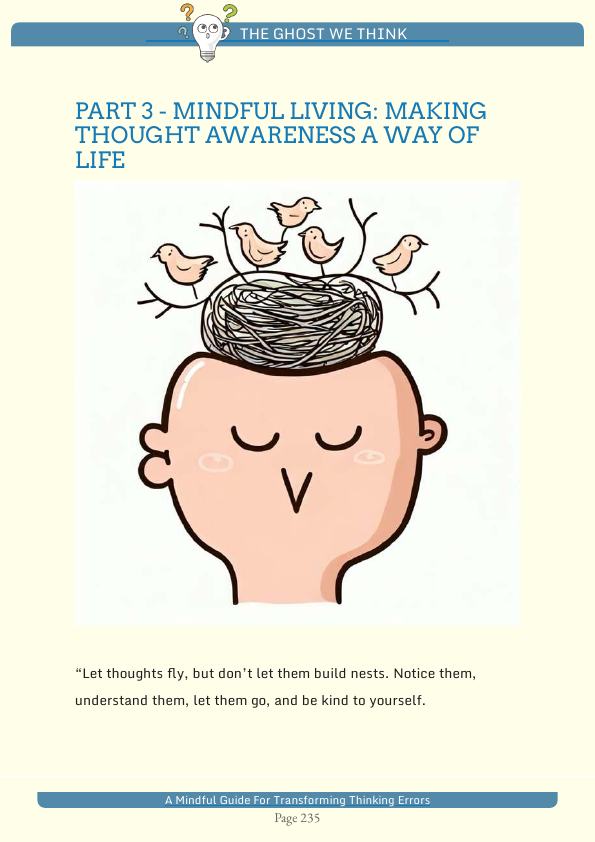
PART 3 - MINDFUL LIVING: MAKING THOUGHT AWARENESS A WAY OF LIFE
“Let thoughts fly, but don’t let them build nests. Notice them, understand them, let them go, and be kind to yourself.”
From Action to Transformation
In Part 2, we moved from awareness to action, exploring 22 real-life scenarios where thinking errors show up. You learned how to recognize distorted thoughts, challenge them, and use practical tools to reframe your thinking. But understanding and action are just the beginning. True transformation comes when these practices become second nature—a way of life that allows you to respond to challenges with clarity and compassion, no matter the circumstances. In Part 3, we’ll focus on making thought awareness and mindfulness part of your daily routine. When you notice and gently release unhelpful thoughts, you create space for calm, focus, and personal growth.
Don’t Let Thoughts Build a Nest
There’s a saying in mindfulness that beautifully captures this process:
“You can’t stop the birds from flying over your head, but you can stop them from building a nest in your mind.”
This reminds us that thoughts—both helpful and unhelpful—will always come and go. The trouble begins when unhelpful thoughts linger and settle in: A worry spirals into catastrophizing. A small mistake grows into a story of “I always fail.” A criticism turns into “I’m not good enough.” Mindfulness teaches us that thoughts are not facts. Just because a thought lands in your mind doesn’t mean it has to stay. Instead, you can notice it, acknowledge it, and let it fly away—like a bird returning to the open sky. In this section, we’ll explore eight ways to cultivate thought awareness and prevent unhelpful thoughts from “building nests” in your mind.
Eight Ways to Cultivate Thought Awareness
1. Relax Your Body, Calm Your Mind
Relaxation creates the stability needed to observe your thoughts clearly. When your body and mind are settled, it’s easier to notice thoughts without getting swept away. Try one of these mindfulness techniques: Mindful Body Stretching: Gently stretch and release tension to create physical ease.
Mindful Breathing: Focus on slow, deep breaths to calm your mind. When your body and mind are steady, awareness naturally follows.
2. Notice & Label the Birds (Thoughts)
Thoughts are like birds—they come and go, often landing unexpectedly. The first step is to notice them and give them a name. Pause and observe: What thoughts are “landing” right now? Label them without judgment: “That’s an angry bird,” “That’s a perfectionist bird,” or “That’s a self-doubt bird.” Naming your thoughts helps you create distance, making it easier to see them for what they are: just thoughts.
3. Let the Thoughts Fly Away
Just as birds don’t stay forever, thoughts can fly away when you let them. Imagine the thought as a bird flying in and out of view. Visualize it leaving your mind: “This is just a thought. I don’t need to keep it.” If the bird doesn’t fly away, remind yourself: “I don’t have to let it build a nest.” Return your focus to the present moment by anchoring yourself in your breath, a sound, or a simple task.
4. Don’t Feed the Nest
Thoughts grow stronger when we feed them with attention and rumination. Instead, practice sensory grounding to redirect your focus. Use your senses: Name five things you can see, four you can touch, three you can hear, two you can smell, and one you can taste. This shifts your attention from the thought to the physical world, reducing its intensity. Ask yourself: “Is this thought helpful?” “What action can I take to move forward right now?”
5. Understand the Triggers
Thoughts often arise from specific triggers—external events, emotional states, or past experiences. Understanding them helps you loosen their grip, but timing is key: Don’t try to analyze when your mind feels overwhelmed or weak. In such moments, focus on grounding first—breathe deeply, engage your senses, or take a mindful walk. Come back to reflection later when you feel more stable. Ask yourself: “Am I stressed, tired, or overwhelmed?” “Does this thought reflect reality, or is it tied to an old belief or fear?” By understanding triggers at the right time, you can approach thoughts with curiosity rather than judgment, making them easier to let go.
6. Practice Self-Compassion
Sometimes the harshest voice in your mind is your own. When negative thoughts arise, treat yourself with kindness and care. Self-compassion involves two essential components:
Gentleness: Replace harsh self-criticism with soft, reassuring words. Use affirmations like: “It’s okay to feel this way. I’m doing my best.” “Everyone struggles with thoughts like these sometimes.” Gentleness helps soothe your inner critic and creates a calm mental space to observe your thoughts. I’m Not Alone: Remind yourself that you’re not alone in your struggles. Everyone experiences difficult thoughts and emotions. This sense of connection reduces feelings of isolation and fosters understanding, which is essential for thought awareness. The song “I’m Not Alone | A Song of Comfort & Connection” reminds us that shared human experiences unite us. Let its message reinforce that you are never truly alone in your journey.
By combining gentleness and the recognition of shared humanity, self-compassion creates a fertile ground for awareness and healing.
7. Journal Your Thoughts (CBT Style)
Journaling is a powerful tool for thought awareness, and using a structured approach like the CBT "Hot Cross Bun" model can make it even more effective. This framework helps you break down your experiences into components: Trigger: What event or situation prompted the thought? Thought: What was the exact thought that arose? Feeling: What emotions came with it? Body Sensation: What physical sensations did you notice (e.g., tension, racing heart)? Behavior: How did you respond or act? Past Experience: Does this thought connect to any past events or patterns? Example Entry: Trigger: My boss sent me a vague email. Thought: “She’s disappointed in my work.” Feeling: Anxiety. Body Sensation: Tension in my shoulders. Behavior: Avoided replying right away. Past Experience: Childhood experience where I was bullied and criticised
By breaking the experience into parts, journaling slows down your mental process, allowing you to see patterns and understand how your thoughts affect your feelings, behaviors, and body. Over time, this awareness makes it easier to respond with balance and clarity.
8. Create a Mindful Mantra
Mantras are short, powerful phrases that help ground you when your thoughts spiral. They serve as a mental anchor, reminding you to slow down and return to the present moment. Choose a mantra that resonates with you, such as: “This is just a thought—it will pass.” “Breathe in calm, breathe out doubt.” “Pause, notice, let it go.” Repeat the mantra silently or aloud when your thoughts feel overwhelming while breathing slowly and deeply. Mantras interrupt unhelpful thought loops and slow your thinking, allowing better clarity and perspective. When your thoughts slow down, you can observe them more objectively, creating space to respond instead of reacting automatically.
Reflection: Keeping Your Mind Clear
Take a moment to reflect:
- What thoughts tend to “build nests” in your mind?
- What triggers or conditions bring these thoughts up most often?
- How can you practice letting go, understanding their roots, and offering yourself kindness?
A Final Thought
Your mind is a peaceful space—it doesn’t have to be cluttered with nests of worry, self-doubt, or negativity. When you practice mindfulness, curiosity, and self-compassion, you can let thoughts come and go like birds passing overhead. To help you embrace this mindset, I’d like to share my song, “Be Grateful & Kindful: A Song On Befriending Adversities.”
This song is a reminder to meet life’s challenges with gratitude and kindness, knowing that every thought, even the difficult ones, has something to teach you. Let it inspire you to approach your mind with patience, balance, and peace.
Summary
Feel free to write down any after-reading insights and thoughts. After reading this, I feel right now...
Conclusion: Becoming the Mindful Conductor of Your Thoughts
As you finish this journey, think of your thoughts as a train traveling between two stations: the heart and the brain. The heart brings emotions, values, and compassion, while the brain offers logic and clarity. Your job is to guide this train with mindfulness and balance, keeping it on track despite the challenges ahead.
Part 1: Landscape of Thinking Errors
In Part 1, you explored the ten thinking errors—mental habits like catastrophizing, mind-reading, and black-or-white thinking—that distort your perspective. These errors are like misaligned tracks, capable of derailing your journey if left unnoticed. By naming and understanding them, you gained the power to shift the train back onto a clearer path.
Part 2: Navigating Real-Life Tracks
In Part 2, you applied what you learned to 22 real-life situations. Whether it was workplace stress, relationship challenges, or personal struggles, you saw how thinking errors can overlap and amplify one another. More importantly, you practiced reframing them using tools like mindfulness, CBT, and ACT, finding ways to navigate even the most complicated tracks.
Part 3: Mindful Living: A Lifelong Journey
Finally, in Part 3, you discovered how to incorporate thought awareness into your everyday life. Using the metaphor of birds and nests, you learned to notice thoughts without letting them settle and control your mental space. By practicing mindfulness, self-compassion, and curiosity, you’ve built the resilience to handle whatever challenges come your way.
Looking Ahead: Conducting Your Train with Wisdom
This journey isn’t about reaching a perfect destination—it’s about learning to navigate life’s ups and downs with clarity and strength. Some days will feel smooth and easy, while others may bring challenges or unexpected detours. But now, you have the tools to pause, reflect, and stay on track toward what truly matters.
The Chinese saying “一念之差” (Yī Niàn Zhī Chā) beautifully captures the power of a single thought to change your path. Like a switch on a railway track, one thought can shift your journey in a new direction—toward growth, resilience, and peace, or toward stress and doubt. The choice lies in how you respond, using mindfulness and purpose to guide your train. You are the conductor of your own journey. With the tools you’ve gained, you can steer your thoughts, stay grounded, and keep moving forward. The path ahead is yours to create—one step, one thought, and one moment at a time. Thank you for taking this journey. The tracks ahead are waiting for you.
Summary
Feel free to write down any after-reading insights and thoughts. After reading this, I feel right now...
Key Tools, Concepts & Metaphors:
1. Acceptance & Commitment Therapy (ACT)
A therapeutic approach that focuses on accepting your inner experiences (thoughts and emotions) without fighting them, committing to values-driven actions, and fostering flexibility in thinking.
2. Cognitive Behavioral Therapy (CBT)
A practical method for identifying and challenging unhelpful thought patterns and replacing them with more balanced and productive ways of thinking.
3. Mindfulness
The practice of being present and fully aware of your thoughts, emotions, and physical sensations without judgment. Mindfulness creates space to respond thoughtfully instead of reacting impulsively.
4. Cognitive Defusion
A core ACT technique where you “unhook” from thoughts by seeing them as mental events, not facts. Techniques include repeating a thought in a silly voice, singing it, or saying, “I’m noticing the thought that…” This practice helps loosen the grip of unhelpful thinking patterns.
5. Name It to Tame It
A mindfulness strategy where you label your emotions (e.g., “This is anxiety” or “This is self-doubt”) to reduce their power. Neuroscience shows this activates your rational brain and calms the emotional response.
6. Self-Compassion
Treating yourself with kindness and understanding, especially when you face struggles or mistakes. Self-compassion helps you move forward without being weighed down by shame or guilt.
7. Thoughts as Birds Metaphor
A mindfulness metaphor suggesting that thoughts are like birds. While you can’t stop them from flying overhead, you can choose not to let them build nests in your mind, allowing you to let unhelpful thoughts go.
8. FEAR (False Evidence Appearing Real)
A helpful acronym that reframes fear as an imagined or exaggerated response rather than a reaction to actual danger, reminding you to approach fear with calm and curiosity.
9. The Stage Metaphor
An ACT concept where you imagine your thoughts as actors on a stage. Instead of getting caught up in their drama, you become the observer—watching the entire play unfold without getting attached to any one part.
10. Train of Thoughts Metaphor
A metaphor that likens your thoughts to a train traveling between two stations: the heart (emotions, values) and the brain (logic, reasoning). Mindfulness helps you stay on track, guiding the train without letting it derail.
11. “一念之差” (Yī Niàn Zhī Chā)
A Chinese saying meaning “the difference of a single thought.” It highlights how one thought can reshape your emotions, choices, and overall direction in life, reinforcing the power of thought awareness.
12. The Ghost Metaphor
A central theme in this book, thinking errors are like ghosts—unseen but haunting your perception. These mental “ghosts” distort reality by feeding off unhelpful thoughts like catastrophizing or perfectionism. Once you notice the ghosts, you can confront and release them, regaining clarity and emotional freedom.
13. Defense Mechanisms
Unconscious mental strategies we use to protect ourselves from uncomfortable emotions or thoughts. Examples include denial, projection, and rationalization. Becoming aware of these patterns can help you respond to challenges with more awareness and authenticity.
14. The Mindful Mirror Practice
The Mindful Mirror practice invites you to see your mind as a mirror that reflects thoughts and emotions without judgment. Use these affirmations to deepen your awareness: Mindful Mirror On The Wall, Name My Emotions Big & Small. Mindful Mirror On The Wall, Scan My Emotions A Little More. Mindful Mirror On The Wall, Help Me Feel & Understand Them All. This practice helps you recognize, understand, and respond to emotions with clarity and compassion, creating space for mindful awareness and balance.
15. Thought Diary (CBT Style)
A Thought Diary helps you track and understand your thoughts, breaking them into components to gain clarity and reduce their emotional intensity. Using a structured CBT approach like the Hot Cross Bun model, you can reflect on:
Trigger: What event or situation prompted the thought? Thought: What was the specific thought that arose? Feeling: What emotions accompanied it? Body Sensation: What physical sensations did you notice? Behavior: How did you respond? Past Experience: Does this thought connect to any recurring patterns or memories?
Summary
Feel free to write down any after-reading insights and thoughts. After reading this, I feel right now...
A Note to Readers
This book is a mindful guide to transforming thinking errors, offering tools to enrich your life and well-being. However, it's not a substitute for professional help, especially when it comes to clinical conditions like depression, anxiety, or other mental health challenges. If you’re experiencing distress that feels overwhelming or persistent, I strongly encourage you to seek guidance from a qualified mental health professional. Mindfulness and self-help can be powerful companions on the journey, but professional care provides the expertise and support needed to navigate more complex challenges. Remember, reaching out for help is an act of strength and self-compassion. You don’t have to face life’s struggles alone.
About the Author
Dr. Phang Cheng Kar (Zhen-Phang), M.D., is a highly respected consultant psychiatrist and mindfulness therapist at Sunway Medical Center. He is passionate about empowering individuals to lead healthier, more balanced lives and created MINDFULGym, Malaysia’s leading mindfulness-based stress reduction and wellness program. He has delivered hundreds of engaging talks and workshops, sharing practical tools for cultivating mindfulness, reducing stress, and enhancing well-being.
A prolific author and thought leader, he has written several impactful books, including I’m Still Human: Understanding Depression with Kindness and NOW: Who Wants to Learn MINDFULGym? — 12 Mindful Tools for Stress Reduction & Wellness. His writing blends professional expertise with deep Buddhist wisdom, making complex mental health concepts accessible and relatable.
In addition to his clinical and teaching roles, he founded the Malaysia Association for Mindfulness Practice & Research (MMPR) and the Kuala Lumpur Buddhist Mental Health Association (BMHA). Known for his warm, approachable style, he champions mindfulness, kindness, and resilience through workshops, books, advocacy, and community mental-health initiatives.